Civil Services Examination · Question 62
Consider the following phenomena : 1. Light is affected by gravity. 2. The Universe is constantly expanding. 3. Matter warps its surrounding space-time. Which of the above is/are the prediction/predictions of Albert Einstein's General Theory of Relativity, often discussed in media ?
Show answer & explanationShow explanation
Answer: (D) 1, 2 and 3
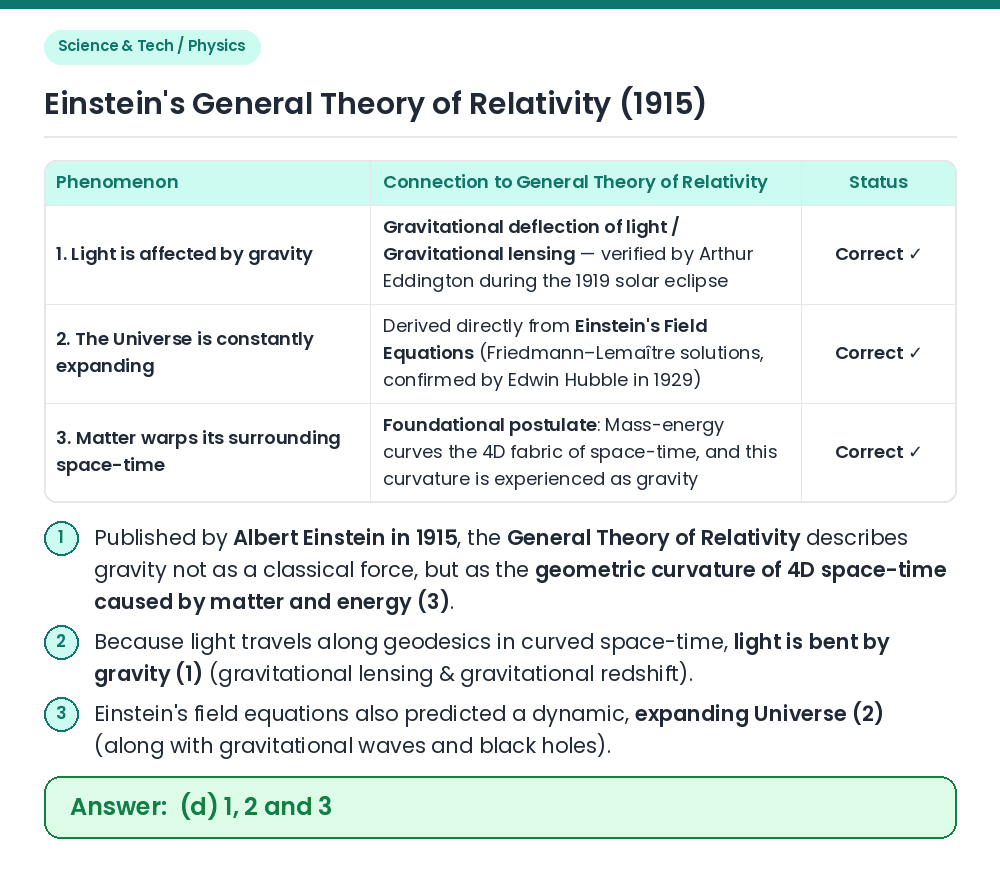
Concept: Core postulates and observational predictions of Albert Einstein's General Theory of Relativity (1915). Phenomenon 3 — Space-Time Curvature: General Relativity posits that massive objects warp (curve) the four-dimensional fabric of surrounding space-time; as physicist John Archibald Wheeler summarized: 'Spacetime tells matter how to move; matter tells spacetime how to curve' ⇒ Phenomenon 3 is correct. Phenomenon 1 — Gravitational Bending of Light: Because space-time is curved by mass, light rays passing near a massive body follow a curved path (Gravitational Lensing, first confirmed by Sir Arthur Eddington during the 1919 solar eclipse) and experience gravitational redshift ⇒ Phenomenon 1 is correct. Phenomenon 2 — Expanding Universe: Einstein's field equations of General Relativity naturally implied a non-static (expanding or contracting) universe, as shown by Alexander Friedmann (1922) and Georges Lemaître (1927) and observationally confirmed by Edwin Hubble (1929) ⇒ Phenomenon 2 is correct. Result: All three phenomena (1, 2 and 3) are associated with General Relativity, so option (d) is correct. Related Facts: • Gravitational Waves (LIGO, 2015/2017 Nobel Prize): Ripples in space-time predicted by Einstein in 1916, directly detected for the first time by LIGO in September 2015 from merging black holes (winning the 2017 Physics Nobel Prize). • Gravitational Time Dilation: Clocks run slower in stronger gravitational fields — a relativistic effect that must be corrected for daily in GPS satellite atomic clocks! • Cosmological Constant (Λ): Einstein initially added Λ to keep the universe static, later calling it his 'biggest blunder' after Hubble proved the universe was expanding (today Λ models Dark Energy). Correct Answer: (d) 1, 2 and 3