Civil Services Examination · Question 59
With reference to the circumstances in Indian agriculture, the concept of "Conservation Agriculture" assumes significance. Which of the following fall under the Conservation Agriculture ? 1. Avoiding the monoculture practices 2. Adopting minimum tillage 3. Avoiding the cultivation of plantation crops 4. Using crop residues to cover soil surface 5. Adopting spatial and temporal crop sequencing/crop rotations Select the correct answer using the code given below :
Show answer & explanationShow explanation
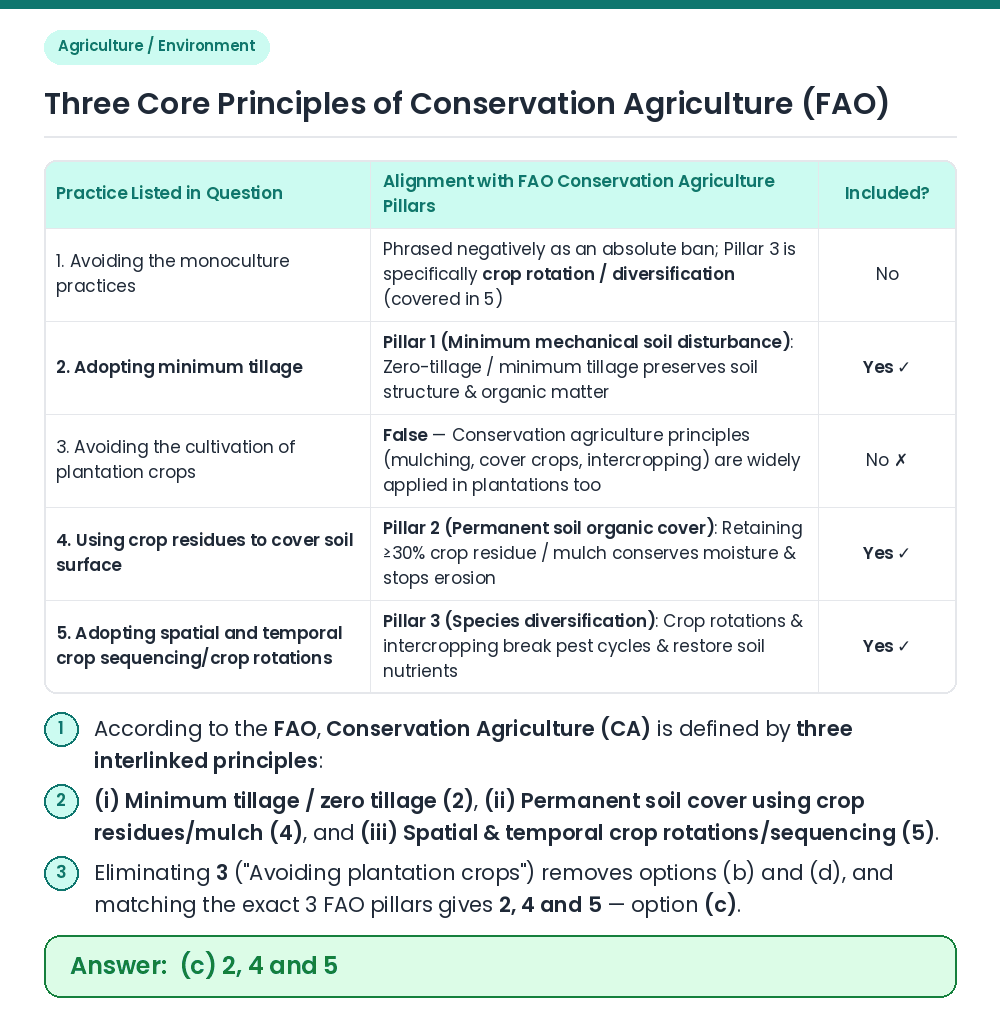
Answer: (C) 2, 4 and 5
Concept: The three foundational pillars of 'Conservation Agriculture' (CA) as defined by the Food and Agriculture Organization (FAO). Eliminate Statement 3 First — Shortcut: Conservation Agriculture does NOT require avoiding the cultivation of plantation crops (in fact, minimum soil disturbance and cover cropping are encouraged in plantations) ⇒ Statement 3 is incorrect ⇒ Eliminate options (a), (b), and (d) immediately! Verify the Three Official FAO Pillars: • Pillar 1 — Minimum mechanical soil disturbance: Adopting minimum tillage / zero tillage (Statement 2). • Pillar 2 — Permanent soil organic cover: Using crop residues / mulch to cover at least 30% of the soil surface (Statement 4). • Pillar 3 — Species diversification: Adopting spatial and temporal crop sequencing / crop rotations (Statement 5). Result: Statements 2, 4, and 5 constitute the exact three pillars of Conservation Agriculture, making option (c) correct. Related Facts: • Benefits in Indian Agriculture: Prevents stubble burning (by retaining crop residue on soil using Happy Seeder machines), conserves irrigation water by 20–30%, increases soil organic carbon, and reduces diesel/tillage costs. • Happy Seeder & Zero-Till Drill: Tractor-mounted implements that allow sowing wheat directly into standing rice stubble without burning residues or ploughing the field. • Note on Statement 1: While crop diversification (5) moves away from continuous monoculture, every option containing 1 in the paper — (a) and (d) — also contains the patently false statement 3 ('avoiding plantation crops'), leaving (c) 2, 4 and 5 as the unambiguous answer. Correct Answer: (c) 2, 4 and 5