Civil Services Examination · Question 56
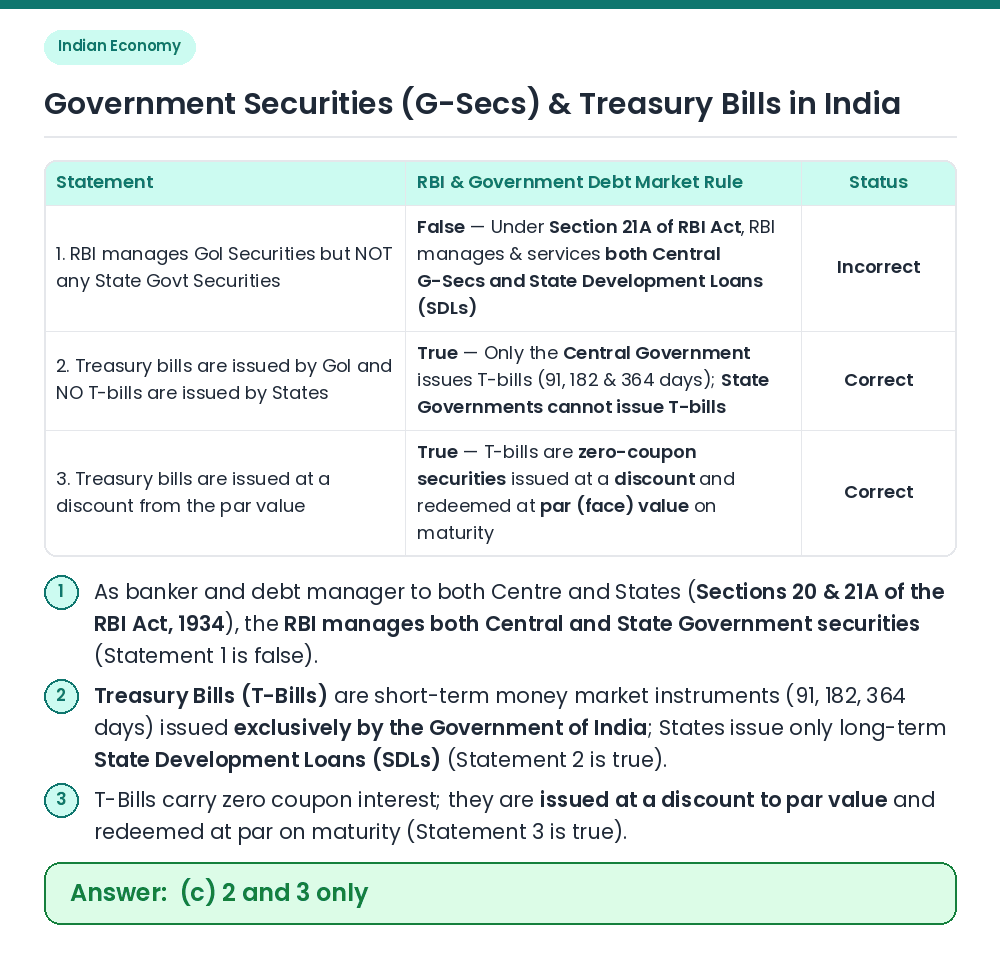
Consider the following statements : 1. The Reserve Bank of India manages and services Government of India Securities but not any State Government Securities. 2. Treasury bills are issued by the Government of India and there are no treasury bills issued by the State Governments. 3. Treasury bills offer are issued at a discount from the par value. Which of the statements given above is/are correct ?
Show answer & explanationShow explanation
Answer: (C) 2 and 3 only
Concept: Role of RBI as Public Debt Manager and features of Treasury Bills (T-Bills) versus State Development Loans (SDLs). Statement 1: Under Sections 20 and 21A of the RBI Act, 1934 (and the Government Securities Act, 2006), the RBI acts as debt manager for BOTH the Central Government and State Governments, managing Central G-Secs as well as State Government Securities (State Development Loans - SDLs) ⇒ Statement 1 is incorrect. Statement 2: Treasury Bills (91-day, 182-day, and 364-day short-term debt instruments) are issued solely by the Central Government; State Governments do not issue Treasury Bills (they only issue dated long-term bonds called SDLs) ⇒ Statement 2 is correct. Statement 3: Treasury Bills are zero-coupon securities — they pay no periodic interest; instead, they are issued at a discount to their face (par) value and redeemed at par value upon maturity ⇒ Statement 3 is correct. Result: Statements 2 and 3 are correct, so option (c) is the right answer. Related Facts: • Yield Calculation Example: A ₹100 face-value 91-day T-bill might be issued at ₹98.20 (at a discount of ₹1.80) and redeemed at ₹100 on maturity, with ₹1.80 representing the investor's return. • Cash Management Bills (CMBs): Introduced in 2010 by GoI and RBI for maturities of less than 91 days to meet temporary cash-flow mismatches of the Central Government. • Ways and Means Advances (WMA): Temporary overdraft/loan facility provided directly by RBI to both the Central and State Governments to bridge short-term revenue-expenditure mismatches. Correct Answer: (c) 2 and 3 only