Civil Services Examination · Question 60
The term "sixth mass extinction/sixth extinction" is often mentioned in the news in the context of the discussion of
Show answer & explanationShow explanation
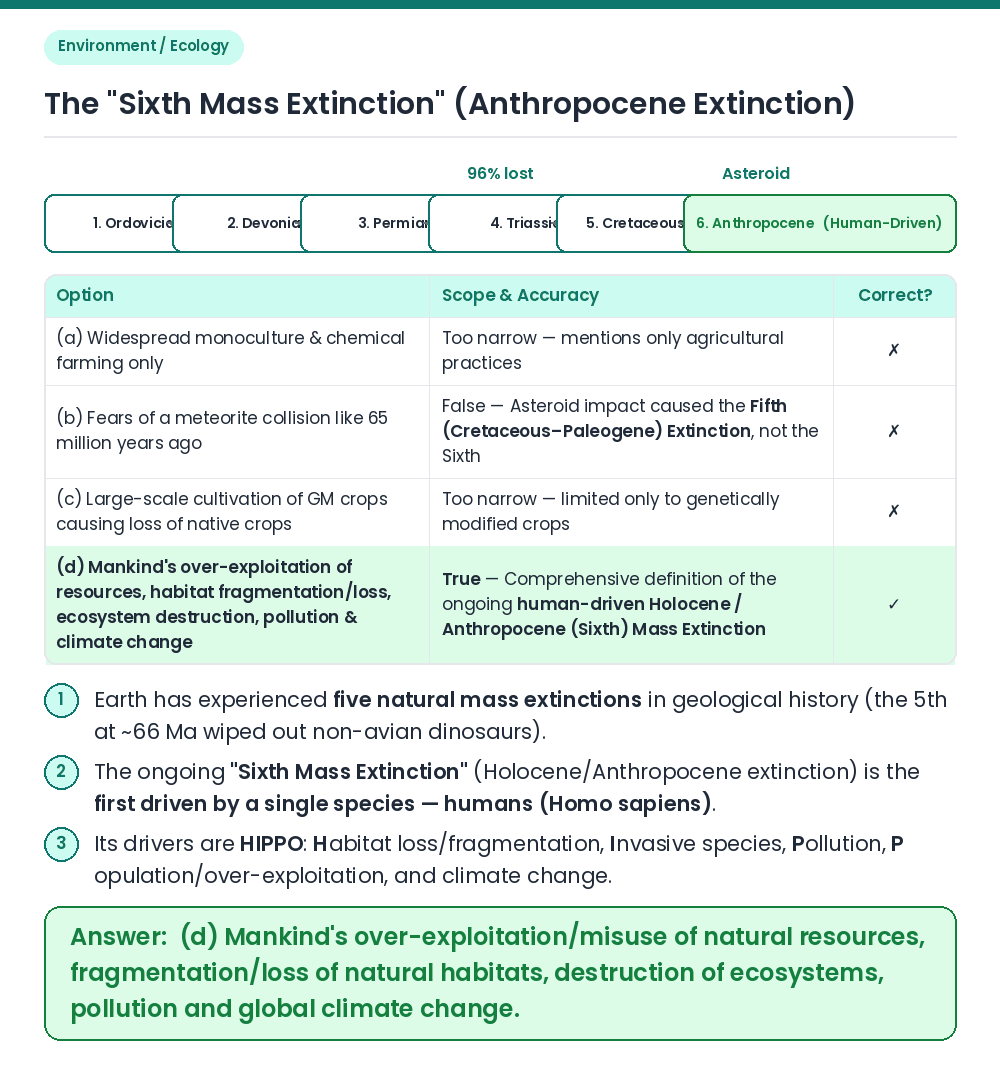
Answer: (D) Mankind's over-exploitation/misuse of natural resources, fragmentation/loss of natural habitats, destruction of ecosystems, pollution and global climate change.
Concept: Meaning and drivers of the ongoing 'Sixth Mass Extinction' (Holocene or Anthropocene Extinction). Distinguish from Previous Five Extinctions: Unlike the previous five mass extinctions caused by natural phenomena (volcanism, glaciation, or the Chicxulub meteorite impact 66 million years ago that ended the Cretaceous period in option b), the current sixth mass extinction is entirely anthropogenic (human-induced). Identify Comprehensive Drivers: Current species extinction rates are 100 to 1,000 times higher than natural background rates due to mankind's over-exploitation of resources, habitat fragmentation/loss, ecosystem destruction, pollution, and global climate change ⇒ Matches option (d). Result: Option (d) accurately and comprehensively describes the context of the sixth mass extinction. Related Facts: • The 'Big Five' Mass Extinctions: (1) End-Ordovician (~444 Ma), (2) Late Devonian (~372 Ma), (3) End-Permian / 'The Great Dying' (~252 Ma — largest, wiping out ~96% of marine species), (4) End-Triassic (~201 Ma), and (5) End-Cretaceous / K–Pg (~66 Ma — wiped out dinosaurs). • Pulitzer-Winning Book: Elizabeth Kolbert's book 'The Sixth Extinction: An Unnatural History' (2014) popularized the term globally. • HIPPO Acronym (E.O. Wilson): Summarizes the main anthropogenic causes of biodiversity loss — Habitat destruction, Invasive species, Pollution, Human Overpopulation, and Overharvesting. Correct Answer: (d) Mankind's over-exploitation/misuse of natural resources, fragmentation/loss of natural habitats, destruction of ecosystems, pollution and global climate change.