Civil Services Examination · Question 75
Which one of the following statements does not apply to the system of Subsidiary Alliance introduced by Lord Wellesley ? (Italicized word: not)
Show answer & explanationShow explanation
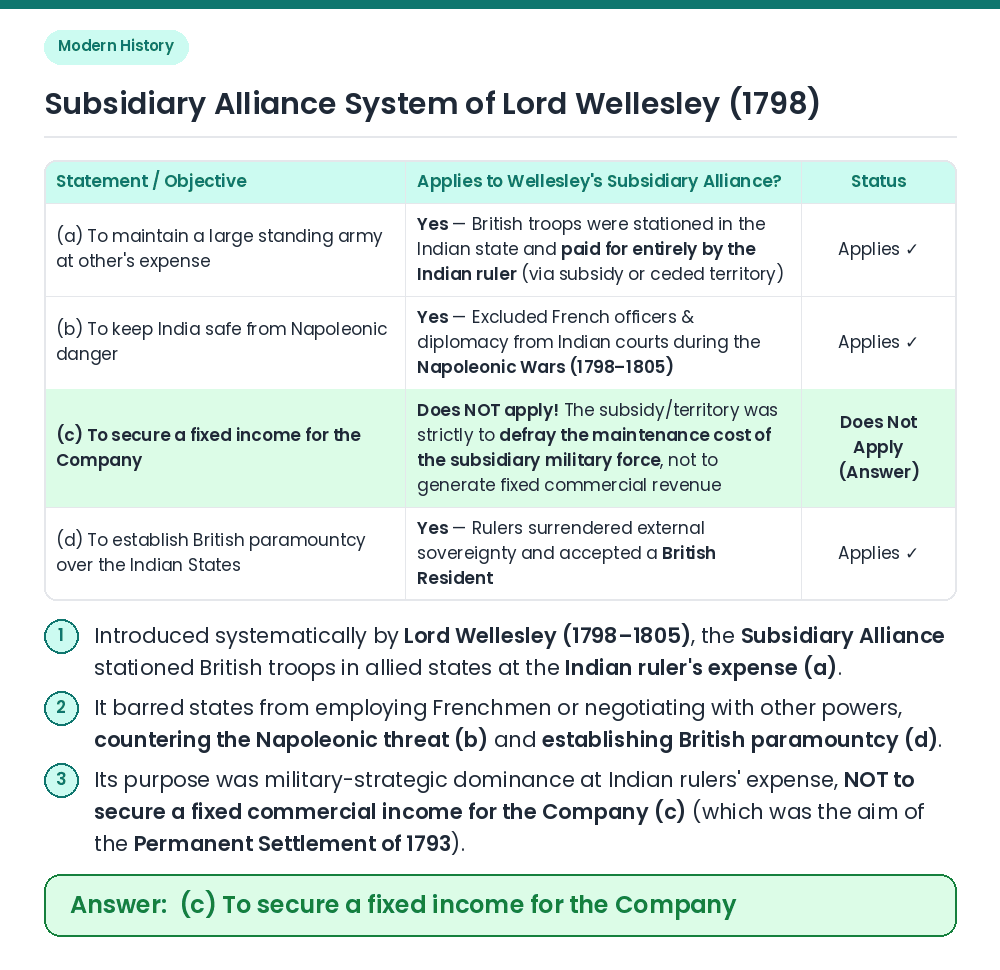
Answer: (C) To secure a fixed income for the Company
Concept: Strategic and political objectives of the Subsidiary Alliance system expanded by Governor-General Lord Wellesley (1798–1805). Check Statements that Apply — a, b, d: • (a) Under the treaty, the British stationed a permanent subsidiary military force inside the Indian ruler's territory, and the ruler had to pay an annual subsidy (or cede territory) for its upkeep ⇒ Maintained a large standing army at others' expense. • (b) Allied rulers were prohibited from employing any non-British Europeans (especially the French) without British permission, neutralizing the threat of Napoleon Bonaparte allying with Indian princes ⇒ Kept India safe from Napoleonic danger. • (d) Rulers surrendered their foreign policy and defence to the Company and accepted a British Resident at their court ⇒ Established British paramountcy over Indian States. Identify Statement that Does NOT Apply — c: 'Securing a fixed income for the Company' was the objective of Lord Cornwallis's Permanent Settlement of land revenue (1793), NOT Wellesley's Subsidiary Alliance (where subsidies merely covered troop maintenance costs). Result: Statement (c) does not apply to the Subsidiary Alliance, making option (c) the right answer. Related Facts: • Pioneer of the System: The practice of hiring out European troops to Indian princes was first pioneered by French Governor Dupleix in the late 1740s, later adopted by Clive (Awadh, 1765) and perfected by Lord Wellesley (1798–1805). • Chronological Order of States Signing Wellesley's Subsidiary Alliance: Hyderabad (1798 & 1800 — first state), Mysore (1799), Tanjore (Oct 1799), Awadh (Nov 1801), Peshwa (Treaty of Bassein, Dec 1802), Bhonsle of Berar (Dec 1803), and Scindia (Feb 1804). Correct Answer: (c) To secure a fixed income for the Company