Civil Services Examination · Question 92
Right to Privacy is protected as an intrinsic part of Right to Life and Personal Liberty. Which of the following in the Constitution of India correctly and appropriately imply the above statement ?
Show answer & explanationShow explanation
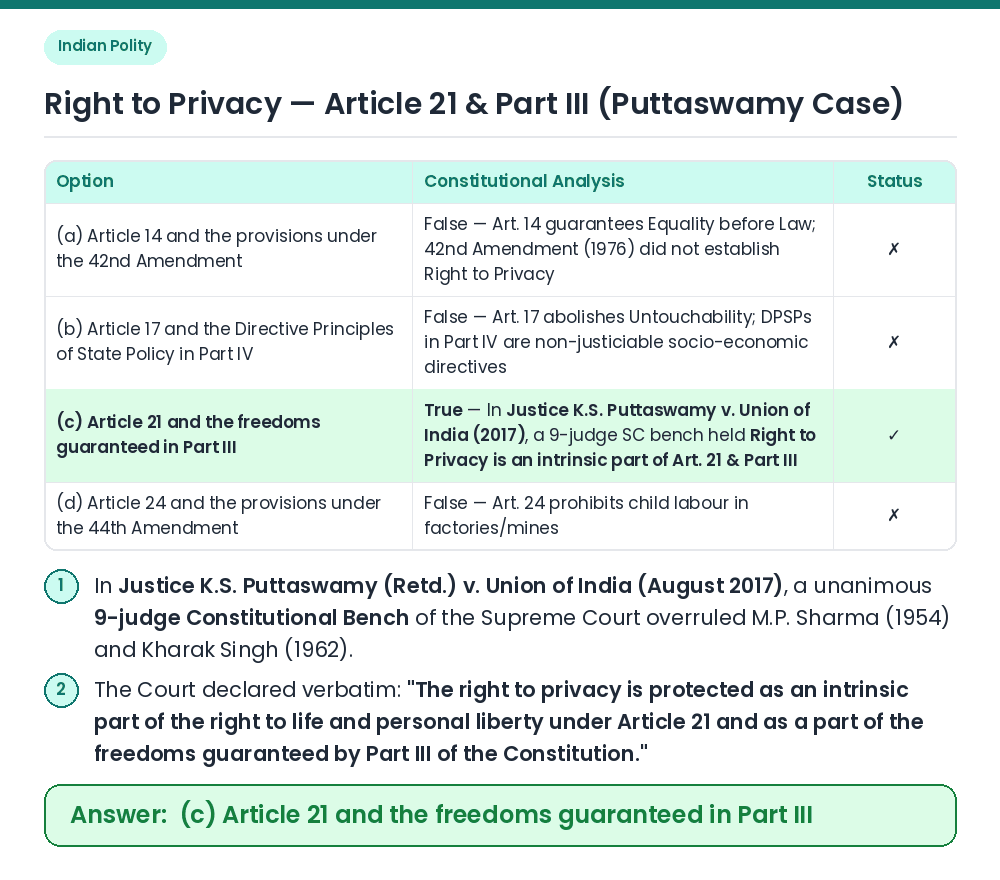
Answer: (C) Article 21 and the freedoms guaranteed in Part III
Concept: Constitutional basis of the Fundamental Right to Privacy as declared by the Supreme Court of India. Landmark Judgment — Justice K.S. Puttaswamy v. Union of India, 24 August 2017: A 9-judge Constitution Bench of the Supreme Court unanimously ruled: 'The right to privacy is protected as an intrinsic part of the right to life and personal liberty under Article 21 and as a part of the freedoms guaranteed by Part III of the Constitution.' Notice Verbatim Question Framing: The question stem and correct option (c) are lifted directly from the operative conclusion of the Supreme Court's 2017 Puttaswamy judgment! Result: Article 21 and the freedoms guaranteed in Part III correctly and appropriately imply the statement, making option (c) correct. Related Facts: • Overruled Judgments: The 9-judge bench overruled the earlier Supreme Court decisions in M.P. Sharma v. Satish Chandra (1954, 8-judge bench) and Kharak Singh v. State of U.P. (1962, 6-judge bench) to the extent they held that the Constitution did not specifically protect the right to privacy. • Three-Fold Test for Restricting Privacy (Proportionality Test): Any state restriction on privacy must satisfy: (1) Legality (existence of a valid law), (2) Legitimate State Aim (need), and (3) Proportionality (rational nexus and least restrictive measure). • Data Protection Committee: Following this judgment, the Government constituted the Justice B.N. Srikrishna Committee (2017), culminating in the Digital Personal Data Protection (DPDP) Act, 2023. Correct Answer: (c) Article 21 and the freedoms guaranteed in Part III