Civil Services Examination · Question 95
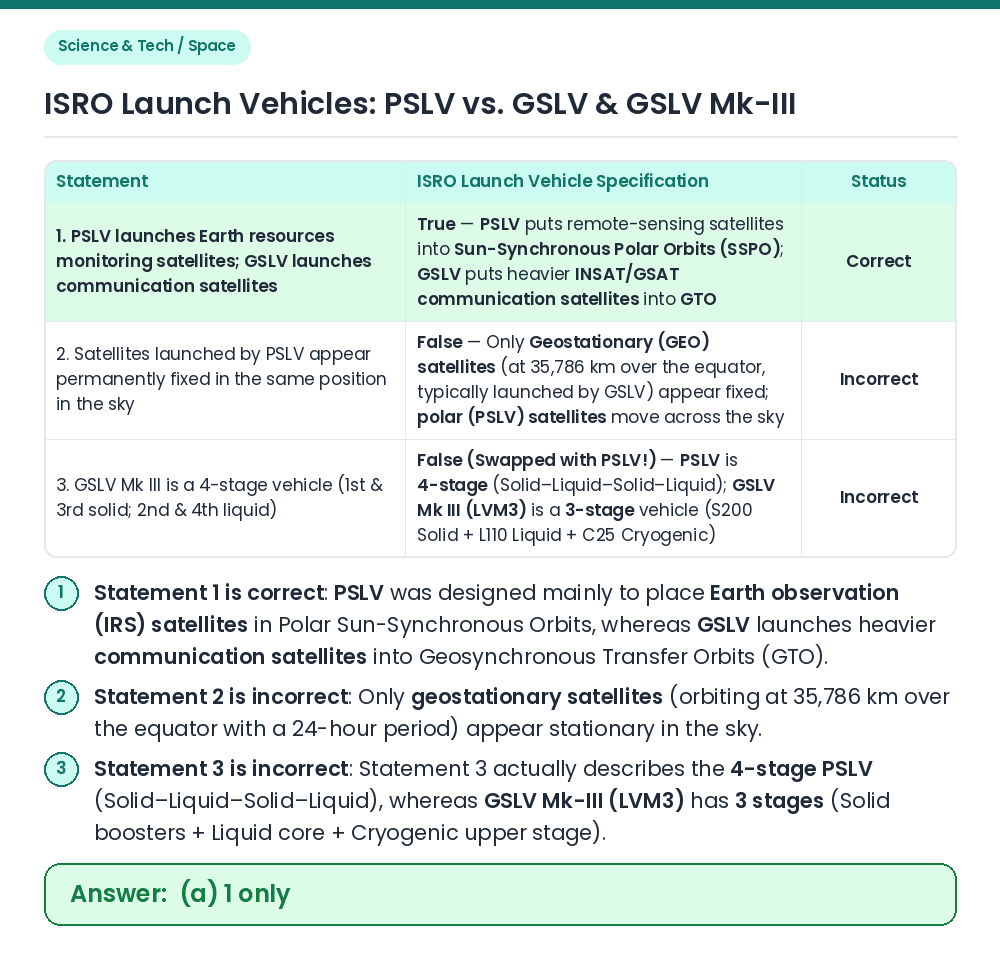
With reference to India's satellite launch vehicles, consider the following statements : 1. PSLVs launch the satellites useful for Earth resources monitoring whereas GSLVs are designed mainly to launch communication satellites. 2. Satellites launched by PSLV appear to remain permanently fixed in the same position in the sky, as viewed from a particular location on Earth. 3. GSLV Mk III is a four-staged launch vehicle with the first and third stages using solid rocket motors; and the second and fourth stages using liquid rocket engines. Which of the statements given above is/are correct ?
Show answer & explanationShow explanation
Answer: (A) 1 only
Concept: Design architecture, staging, and orbital missions of ISRO's Polar Satellite Launch Vehicle (PSLV) and Geosynchronous Satellite Launch Vehicle (GSLV / GSLV Mk-III). Statement 1: PSLV is primarily used to launch Earth observation / remote sensing (IRS/Cartosat/Resourcesat) satellites into Polar Sun-Synchronous Orbits (~600–900 km altitude), whereas GSLV is designed mainly to launch heavier INSAT/GSAT communication satellites into Geosynchronous Transfer Orbit (GTO) ⇒ Statement 1 is correct. Statement 2: A satellite appears permanently fixed at the same spot in the sky only when placed in a Geostationary Earth Orbit (GEO, ~35,786 km directly above the equator, matching Earth's 24-hour rotation period). Satellites launched into polar orbits by PSLV revolve from pole to pole (~90–100 min period) and do NOT appear stationary in the sky ⇒ Statement 2 is incorrect. Statement 3 — The PSLV vs GSLV Mk-III Swap: • PSLV is the 4-stage launch vehicle with 1st and 3rd stages using solid rocket motors (HTPB) and 2nd (Vikas engine) and 4th stages using liquid rocket engines! • GSLV Mk-III (now renamed LVM3) is a three-stage heavy-lift launch vehicle: (1) two S200 solid strap-on boosters, (2) L110 liquid core stage (two Vikas engines), and (3) C25 indigenous cryogenic upper stage (CE-20 engine using liquid H₂ and liquid O₂) ⇒ Statement 3 is incorrect. Result: Only statement 1 is correct, making option (a) the right answer. Related Facts: • 'Workhorse of ISRO': PSLV has launched historic missions including Chandrayaan-1 (2008), Mangalyaan / MOM (2013), Astrosat (2015), and Aditya-L1 (2023), and held a world record in Feb 2017 by launching 104 satellites in a single flight (PSLV-C37). • GSLV Mk-III / LVM3 ('Bahubali'): Capable of placing 4,000 kg (4 tonnes) into GTO and 8,000 kg (8 tonnes) into LEO; launched Chandrayaan-2 (2019), Chandrayaan-3 (2023), and human-rated for the Gaganyaan mission. Correct Answer: (a) 1 only