Civil Services Examination · Question 1
Directions for the following 8 (eight) items: Read the following seven passages and answer the items that follow each passage. Your answers to these items should be based on the passages only. Passage – 1 Political theorists no doubt have to take history of injustice, for example, untouchability, seriously. The concept of historical injustice takes note of a variety of historical wrongs that continue into the present in some form or the other and tend to resist repair. Two reasons might account for resistance to repair. One, not only are the roots of injustice buried deep in history, injustice itself constitutes economic structures of exploitation, ideologies of discrimination and modes of representation. Two, the category of historical injustice generally extends across a number of wrongs such as economic deprivation, social discrimination and lack of recognition. This category is complex, not only because of the overlap between a number of wrongs, but because one or the other wrong, generally discrimination, tends to acquire partial autonomy from others. This is borne out by the history of repair in India. What is the main idea that we can infer from the passage?
Show answer & explanationShow explanation
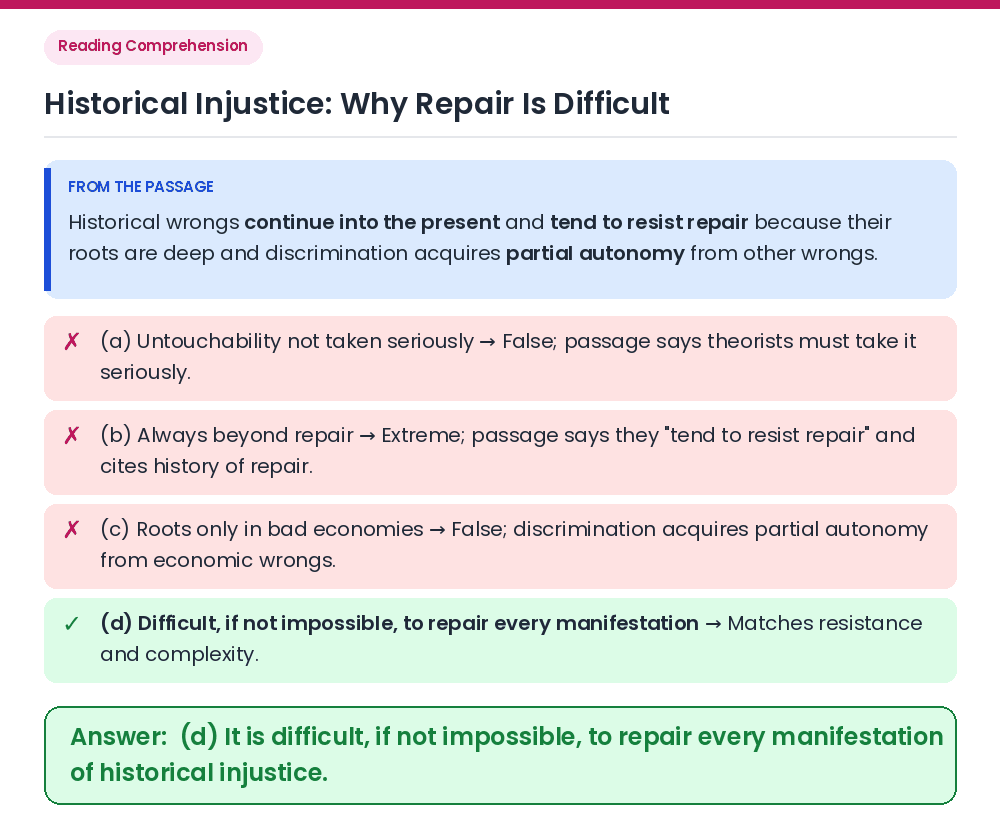
Answer: (D) It is difficult, if not impossible, to repair every manifestation of historical injustice.
Core Idea: The passage explains that historical wrongs continue into the present and 'tend to resist repair' due to deep structural roots and overlapping wrongs. Evaluate Options: ⇒ (a) Incorrect: The opening sentence notes theorists 'no doubt have to take history of injustice... seriously'. ⇒ (b) Incorrect: 'Always beyond repair' is extreme; the passage says they 'tend to resist repair' and mentions 'history of repair in India'. ⇒ (c) Incorrect: Discrimination 'tends to acquire partial autonomy' from economic deprivation, so it is not merely rooted in bad economies. Result: Because wrongs overlap and discrimination gains autonomy, repairing every manifestation of historical injustice is very difficult, if not impossible. Correct Answer: (d) It is difficult, if not impossible, to repair every manifestation of historical injustice.