Civil Services Examination · Question 7
Passage – 6 A bat's wings may look like sheets of skin. But underneath, a bat has the same five fingers as an orangutan or a human, as well as a wrist connected to the same cluster of wrist bones connected to the same long bones of the arm. What can be more curious than that the hand of a man, formed for grasping, that of a mole for digging, the leg of the horse, the paddle of the porpoise, and the wing of the bat, should all be constructed on the same pattern? Which one of the following is the most logical, scientific and rational inference that can be made from the above passage?
Show answer & explanationShow explanation
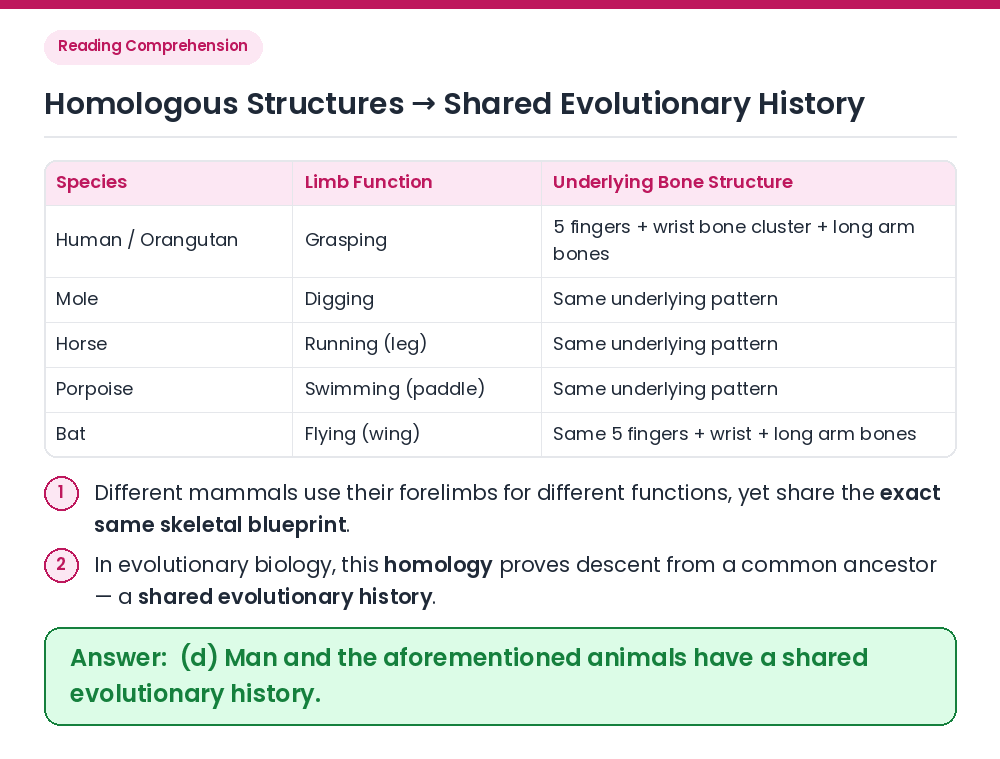
Answer: (D) Man and the aforementioned animals have a shared evolutionary history.
Scientific Principle: The passage (a classic quote from Darwin's On the Origin of Species) describes homologous organs — forelimbs of humans, moles, horses, porpoises, and bats built on the same skeletal pattern despite different functions. Evaluate Options: ⇒ (a) & (b) Incorrect: The passage highlights anatomical similarity across different species, not biodiversity. ⇒ (c) Incorrect: Having the exact same 5-finger, wrist, and arm-bone blueprint is not a mere 'coincidence'. Result: Scientifically, shared anatomical structure (homology) across diverse mammals proves common ancestry, i.e., a shared evolutionary history. Correct Answer: (d) Man and the aforementioned animals have a shared evolutionary history.