Civil Services Examination · Question 100
Which one of the following statements is not correct?
Show answer & explanationShow explanation
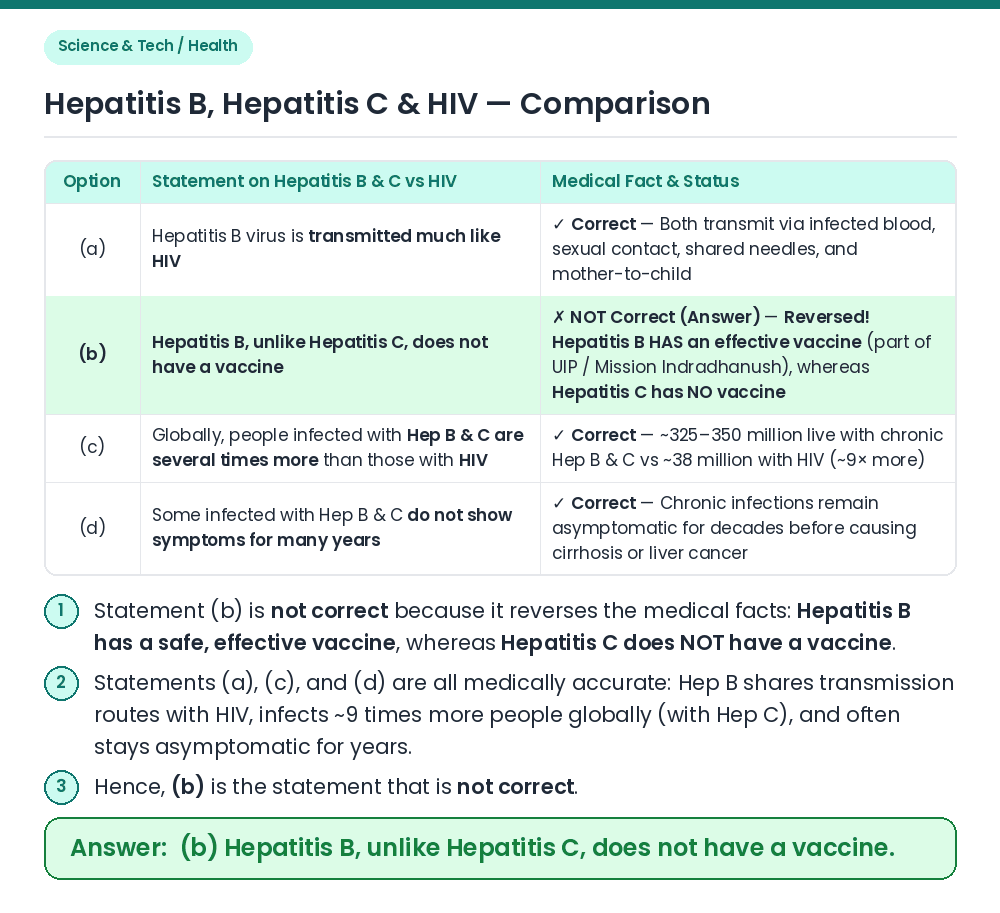
Answer: (B) Hepatitis B, unlike Hepatitis C, does not have a vaccine.
Given / Concept: Compare the transmission, vaccine availability, global prevalence, and clinical course of Hepatitis B (HBV), Hepatitis C (HCV), and HIV. Identifying the Incorrect Statement — b: Hepatitis B has a highly effective recombinant vaccine (included in India's Universal Immunization Programme and given at birth + 6, 10, 14 weeks as part of Pentavalent vaccine), whereas Hepatitis C has NO vaccine available (though it is curable with direct-acting oral antivirals) ⇒ Statement (b) reverses this fact and is NOT correct (Option b ✓). Verifying Correct Statements — a, c, d: ⇒ Option (a): HBV is transmitted parenterally, sexually, and perinatally — much like HIV (and is 50–100 times more infectious than HIV). ⇒ Option (c): Globally, ~325–350 million people live with chronic Hepatitis B and C (~250M+ HBV and ~70M HCV), nearly 9 times the ~38 million living with HIV. ⇒ Option (d): Both HBV and HCV are 'silent killers' that often cause no symptoms for decades until liver cirrhosis or hepatocellular carcinoma develops. Result: Statement (b) is not correct. Related Facts: • Hepatitis Viruses (A to E): Hepatitis A and E are transmitted via the fecal-oral route (contaminated water/food), whereas Hepatitis B, C, and D are blood-borne. • Genome Type: Hepatitis B virus (HBV) is a DNA virus, whereas Hepatitis A, C, D, and E viruses are RNA viruses. Correct Answer: (b) Hepatitis B, unlike Hepatitis C, does not have a vaccine.