Civil Services Examination · Question 52
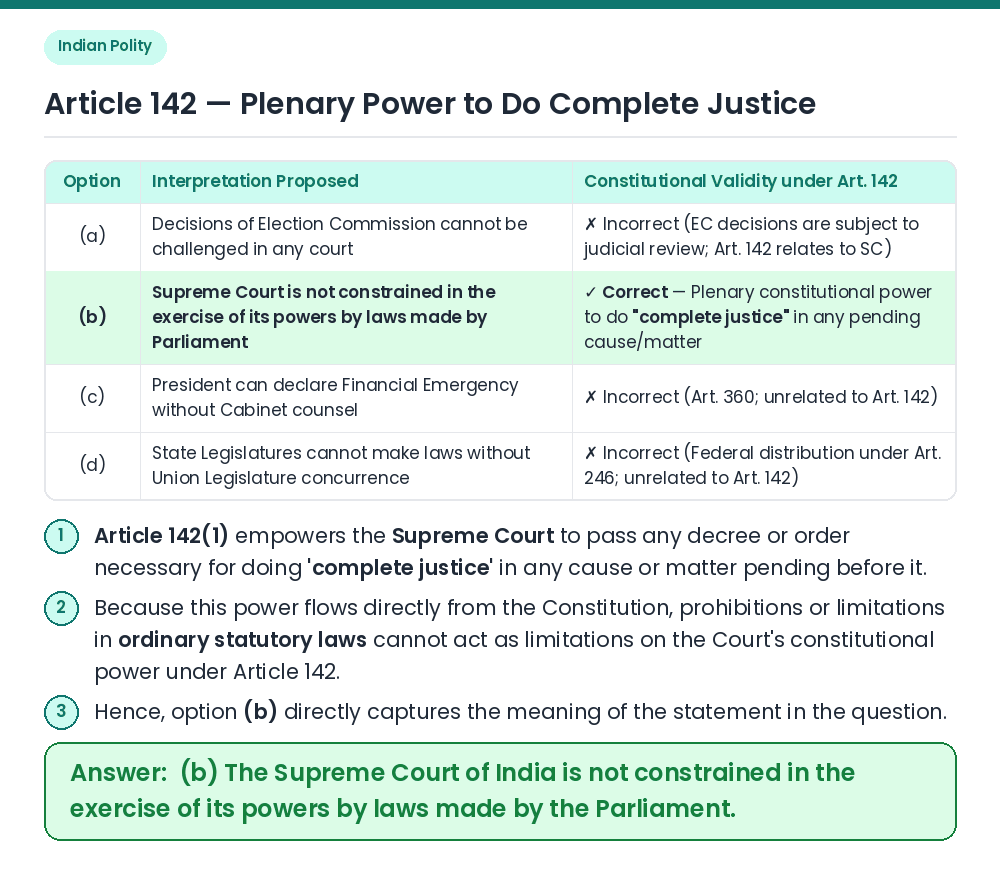
With reference to the Constitution of India, prohibitions or limitations or provisions contained in ordinary laws cannot act as prohibitions or limitations on the constitutional powers under Article 142. It could mean which one of the following?
Show answer & explanationShow explanation
Answer: (B) The Supreme Court of India is not constrained in the exercise of its powers by laws made by the Parliament.
Given / Concept: Article 142(1) of the Constitution vests the Supreme Court of India with plenary power to pass any decree or order necessary for doing 'complete justice' in any cause or matter pending before it. Matching Constitutional Text: In Union Carbide Corp. v. Union of India (1991), the Supreme Court observed that prohibitions or limitations in ordinary laws cannot act as prohibitions or limitations on the constitutional powers of the Supreme Court under Article 142 ⇒ This means the Supreme Court is not constrained by ordinary parliamentary statutes when exercising its plenary power under Article 142 (Option b ✓). Constitutional Nuance Note: While UPSC's official key is (b) based on the Union Carbide dictum, note that in Supreme Court Bar Association v. Union of India (1998), a Constitution Bench clarified that Article 142 powers are supplementary and cannot be used to supplant substantive statutory law directly. Result: Option (b) is the correct answer. Related Facts: • Key Uses of Article 142: Babri Masjid/Ayodhya title verdict (2019), cancellation of coal block allocations (2014), ban on liquor sale along highways (2016), and Vishaka guidelines (1997). • Article 142(2): Empowers the Supreme Court to secure the attendance of any person, discovery of documents, or punishment of contempt of itself. Correct Answer: (b) The Supreme Court of India is not constrained in the exercise of its powers by laws made by the Parliament.