Civil Services Examination · Question 57
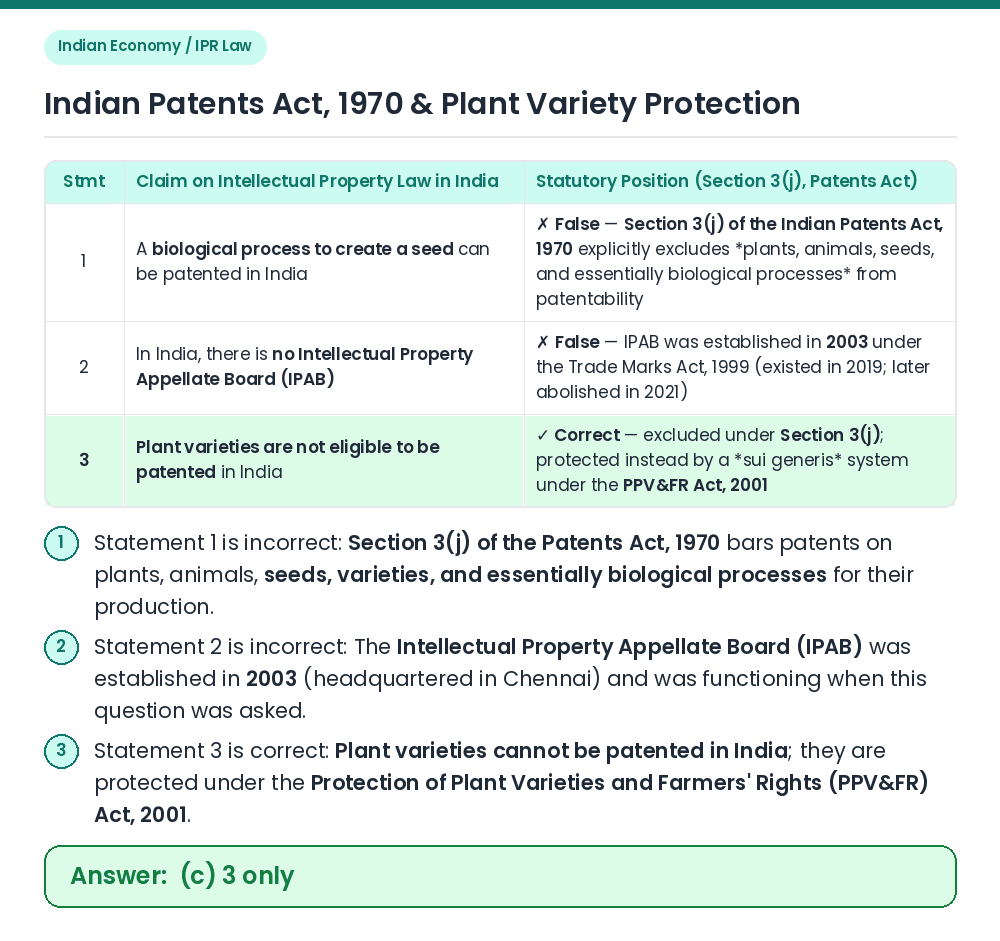
Consider the following statements : 1. According to the Indian Patents Act, a biological process to create a seed can be patented in India. 2. In India, there is no Intellectual Property Appellate Board. 3. Plant varieties are not eligible to be patented in India. Which of the statements given above is/are correct?
Show answer & explanationShow explanation
Answer: (C) 3 only
Given / Concept: Under Article 27.3(b) of the WTO TRIPS Agreement, countries may exclude plants, animals, and essentially biological processes from patentability provided they protect plant varieties by patents or an effective sui generis system. Statements 1 & 3 — Section 3[j] of Indian Patents Act, 1970: Section 3(j) explicitly states that 'plants and animals in whole or any part thereof other than microorganisms, including seeds, varieties and species and essentially biological processes for production or propagation of plants and animals' are NOT inventions and cannot be patented ⇒ Statement 1 is incorrect and Statement 3 is correct. Statement 2 — IPAB: The Intellectual Property Appellate Board (IPAB) was constituted in 2003 under Section 83 of the Trade Marks Act, 1999 (Statement 2 ✗). (Note: IPAB was later abolished by the Tribunals Reforms Act, 2021, transferring jurisdiction to High Courts, but in 2019 it existed). Result: Only Statement 3 is correct. Related Facts: • PPV&FR Act, 2001: India enacted the Protection of Plant Varieties and Farmers' Rights Act, 2001 as a sui generis system recognizing both breeders' and farmers' rights. • Monsanto Bt Cotton Case: Involved the interplay between the Patents Act (Section 3(j)) for biotechnological traits/genes and the PPV&FR Act for plant varieties. Correct Answer: (c) 3 only