Civil Services Examination · Question 1
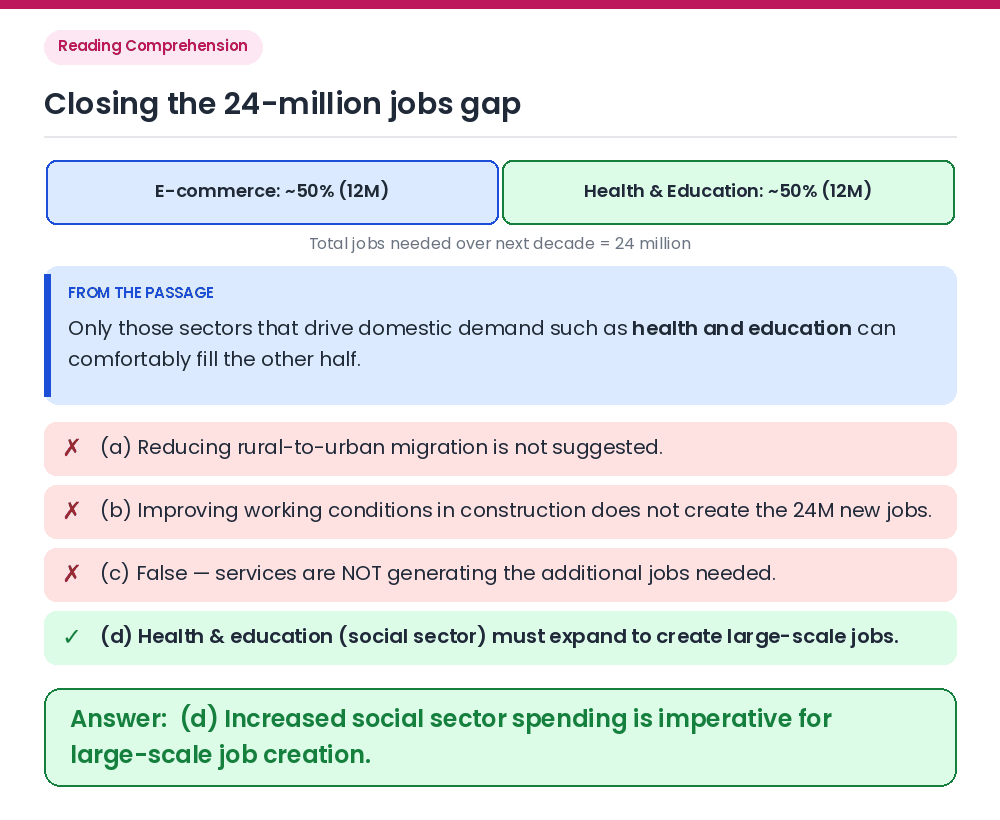
Passage–1 In India, over the last decade or so, labour has been departing agriculture, but is only going to construction and unregistered manufacturing which are not markedly better jobs. Services, where labour tends to be most productive, are not generating the additional jobs the country needs. India will need 24 million or so jobs over the next decade. The new sector, e-commerce, can at best close only half the jobs gap. Only those sectors that drive domestic demand such as health and education can comfortably fill the other half. Which one of the following is best implied in the passage?
Show answer & explanationShow explanation
Answer: (D) Increased social sector spending is imperative for large-scale job creation.
Given / Concept: The passage examines how India can generate 24 million new jobs over the next decade. Passage Analysis: Agriculture-exiting labour goes into low-quality jobs, services are not generating enough additional jobs, and e-commerce can fill at most half the gap. Key Inference: The final sentence states that only domestic-demand sectors like health and education (social sector) can fill the remaining half. Eliminate Others: Options (a) and (b) are not discussed as solutions, and (c) directly contradicts the passage. Result: Higher spending in social sectors (health and education) is imperative for large-scale job creation. Correct Answer: (d) Increased social sector spending is imperative for large-scale job creation.