Civil Services Examination · Question 2
Passage–2 In India, the current focus on the right to privacy is based on some new realities of the digital age. A right is a substantive right only if it works in all situations, and for everyone. A right to free expression for an individual about her exploitation, for instance, is meaningless without actual availability of security that guarantees that private force cannot be used to thwart this right. The role of the State, therefore, is not just to abstain from preventing rightful free expression, but also to actively ensure that private parties are not able to block it. On the basis of the above passage, the following assumptions have been made : 1. State should have some institutions to ensure its appropriate role in a digital society. 2. State should ensure that private parties do not violate the citizens' right to privacy. 3. Digital economy is not compatible with the idea of not violating the citizens' privacy. Which of the above assumptions is/are valid?
Show answer & explanationShow explanation
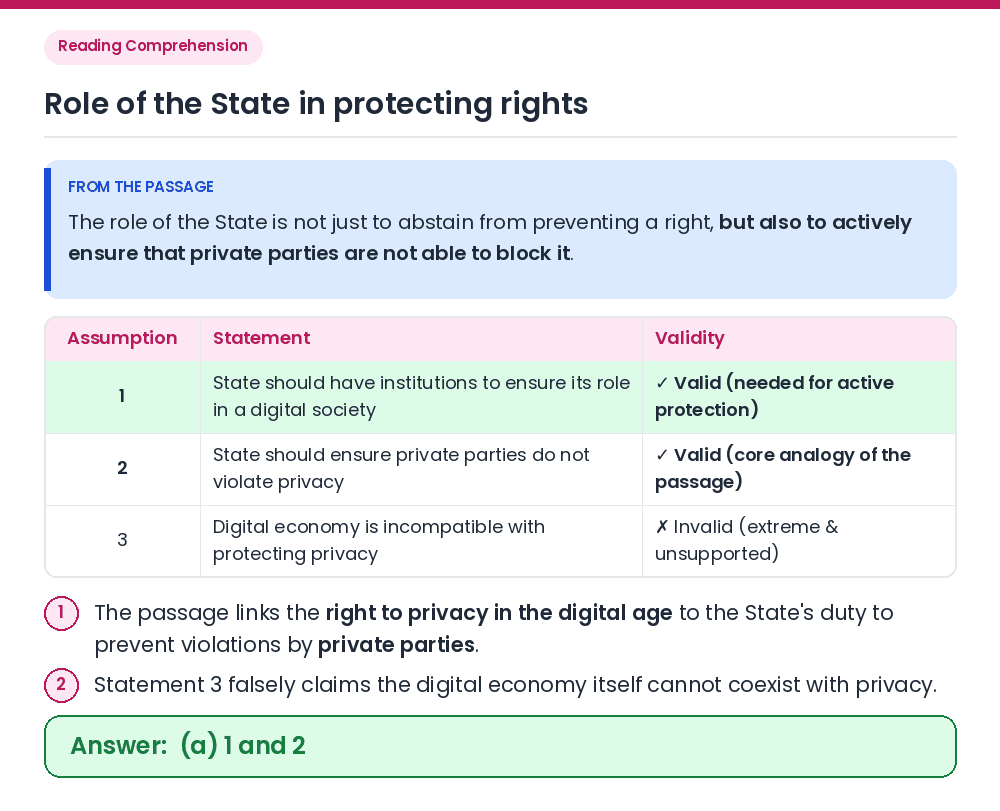
Answer: (A) 1 and 2
Given / Concept: The passage discusses the right to privacy in the digital age and the active duty of the State. Evaluate Assumption 1: For the State to actively guarantee substantive rights in the digital age, institutional mechanisms are implicitly required ⇒ Assumption 1 is valid. Evaluate Assumption 2: Using the analogy of free expression, the author argues the State must actively prevent private parties from violating citizens' rights (privacy) ⇒ Assumption 2 is valid. Evaluate Assumption 3: The passage calls for regulating private violations in the digital age, not declaring the digital economy incompatible with privacy ⇒ Assumption 3 is invalid. Result: Only assumptions 1 and 2 are valid. Correct Answer: (a) 1 and 2