Civil Services Examination · Question 16
The Preamble to the Constitution of India is
Show answer & explanationShow explanation
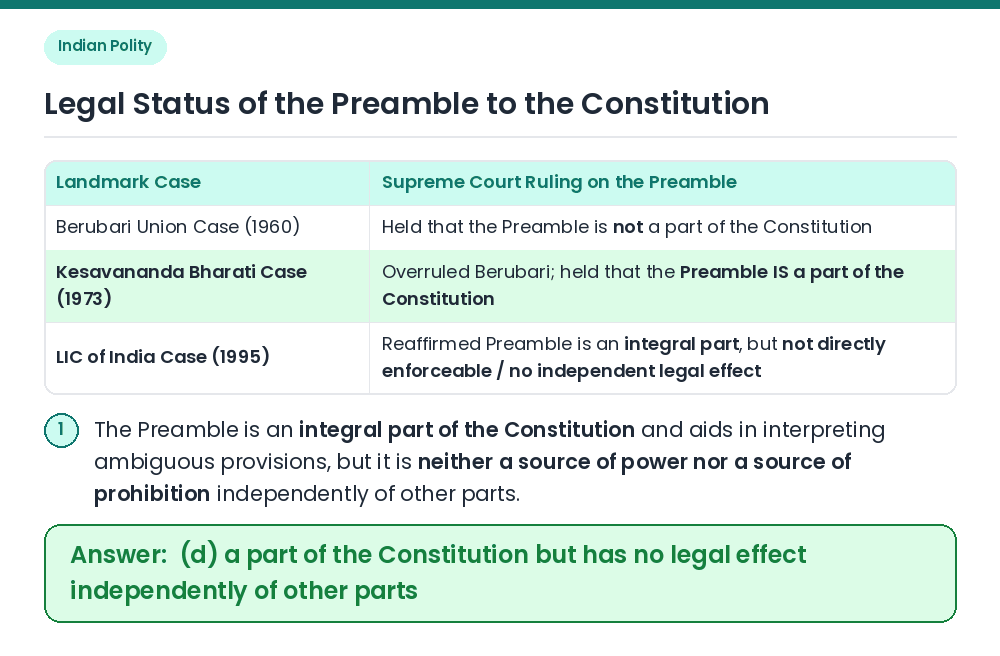
Answer: (D) a part of the Constitution but has no legal effect independently of other parts
Given / Concept: Constitutional status and legal enforceability of the Preamble. Part of the Constitution: In Kesavananda Bharati v. State of Kerala (1973) and LIC of India (1995), the Supreme Court held that the Preamble is an integral part of the Constitution (eliminating option b). Legal Effect: The Preamble is non-justiciable and cannot be enforced in a court of law by itself, yet courts use it to interpret ambiguous provisions of the Constitution ⇒ it has no legal effect independently of other parts (eliminating a and c). Result: The Preamble is a part of the Constitution but has no legal effect independently of other parts. Related Facts: • Origin: Based on the 'Objectives Resolution' moved by Jawaharlal Nehru on 13 December 1946 and adopted on 22 January 1947. • Only Amendment: Amended once by the 42nd Constitutional Amendment Act, 1976, which added 'Socialist', 'Secular', and 'Integrity'. Correct Answer: (d) a part of the Constitution but has no legal effect independently of other parts