Civil Services Examination · Question 19
Consider the following statements : 1. According to the Constitution of India, a person who is eligible to vote can be made a minister in a State for six months even if he/she is not a member of the Legislature of that State. 2. According to the Representation of People Act, 1951, a person convicted of a criminal offence and sentenced to imprisonment for five years is permanently disqualified from contesting an election even after his release from prison. Which of the statements given above is/are correct?
Show answer & explanationShow explanation
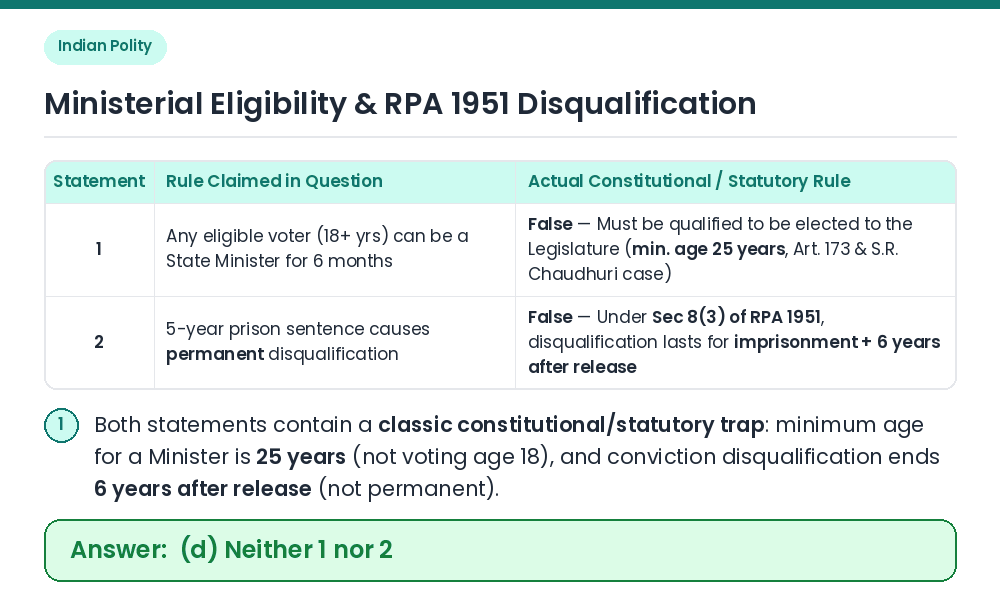
Answer: (D) Neither 1 nor 2
Given / Concept: Appointment of a non-legislator as Minister (Article 164(4)) and conviction-based disqualification (Section 8 of RPA, 1951). Statement 1: While Article 164(4) allows a non-member to be a Minister for up to 6 months, he/she must still possess all qualifications to be elected to the State Legislature (minimum age 25 years under Article 173), whereas a voter only needs to be 18 years old (Article 326) ⇒ Statement 1 is incorrect. Statement 2: Under Section 8(3) of the Representation of the People Act, 1951, a person convicted and sentenced to imprisonment for not less than 2 years is disqualified from the date of conviction and continues to be disqualified for a further period of 6 years since release (not permanently) ⇒ Statement 2 is incorrect. Result: Neither 1 nor 2 is correct. Related Facts: • S.R. Chaudhuri v. State of Punjab (2001): Supreme Court ruled that a non-legislator disqualified from being elected cannot be appointed a Minister under Article 164(4), nor can a person be repeatedly reappointed without winning election. • Lily Thomas v. Union of India (2013): Struck down Section 8(4) of RPA 1951, making disqualification upon conviction (≥2 years sentence) immediate for sitting MPs/MLAs. Correct Answer: (d) Neither 1 nor 2