Civil Services Examination · Question 70
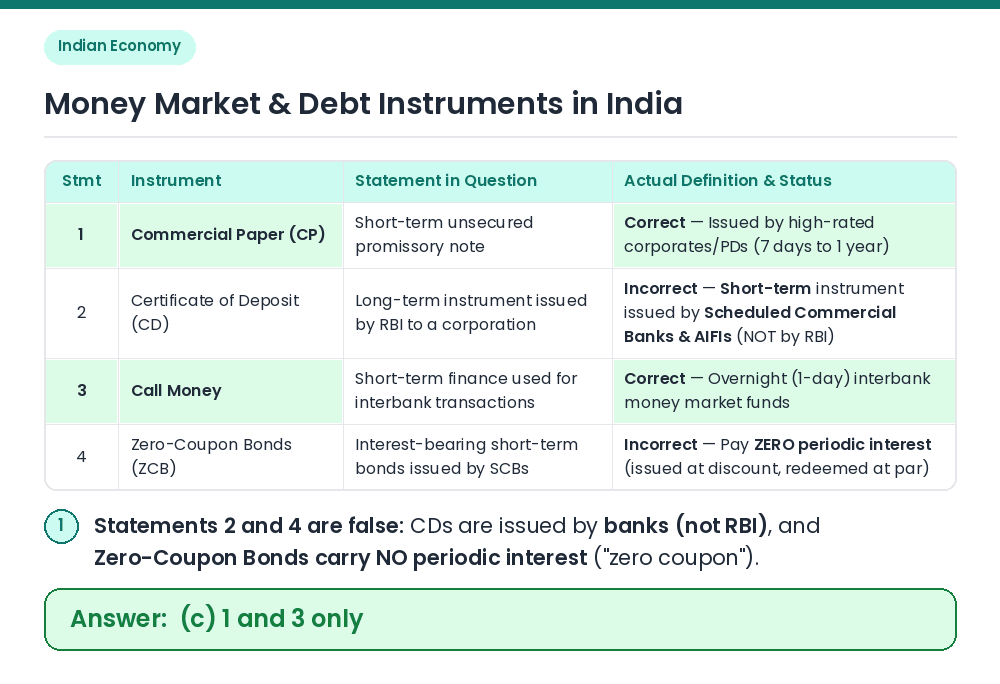
With reference to the Indian economy, consider the following statements : 1. 'Commercial Paper' is a short-term unsecured promissory note. 2. 'Certificate of Deposit' is a long-term instrument issued by the Reserve Bank of India to a corporation. 3. 'Call Money' is a short-term finance used for interbank transactions. 4. 'Zero-Coupon Bonds' are the interest bearing short-term bonds issued by the Scheduled Commercial Banks to corporations. Which of the statements given above is/are correct?
Show answer & explanationShow explanation
Answer: (C) 1 and 3 only
Given / Concept: Characteristics of Indian money market and debt market instruments. Statements 1 & 3: Commercial Paper (CP, introduced in 1990) is a short-term unsecured promissory note issued by creditworthy companies and financial institutions for 7 days to 1 year (⇒ Statement 1 is correct); Call Money is overnight (1-day) short-term finance used by banks for interbank liquidity management (⇒ Statement 3 is correct). Statements 2 & 4: Certificate of Deposit (CD, introduced in 1989) is a short-term negotiable money market instrument issued by Scheduled Commercial Banks and All-India Financial Institutions, NOT by the RBI and NOT long-term (⇒ Statement 2 is incorrect); Zero-Coupon Bonds pay no periodic interest ('coupon' = interest rate, so 'zero-coupon' means non-interest-bearing; they are sold at a discount and redeemed at face value) (⇒ Statement 4 is incorrect). Result: Statements 1 and 3 only are correct. Related Facts: • Call vs. Notice vs. Term Money: Call Money = 1 day (overnight); Notice Money = 2 to 14 days; Term Money = 15 days to 1 year. • Minimum Denomination: Both Commercial Papers (CPs) and Certificates of Deposit (CDs) are issued in minimum denominations of ₹5 lakh and multiples thereof. Correct Answer: (c) 1 and 3 only