Civil Services Examination · Question 71
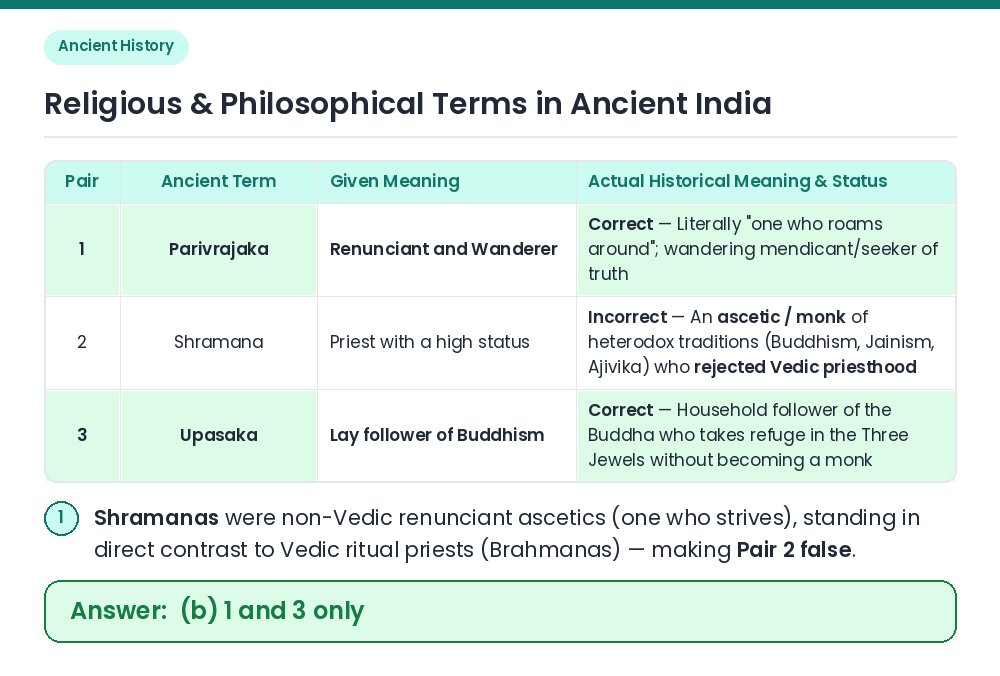
With reference to the cultural history of India, consider the following pairs : 1. Parivrajaka — Renunciant and Wanderer 2. Shramana — Priest with a high status 3. Upasaka — Lay follower of Buddhism Which of the pairs given above are correctly matched?
Show answer & explanationShow explanation
Answer: (B) 1 and 3 only
Given / Concept: Meaning of key religious terms from ancient Indian ascetic and Buddhist traditions. Pairs 1 & 3: 'Parivrajaka' literally means 'one who wanders forth'—a homeless renunciant and wandering seeker (⇒ Pair 1 is correct); 'Upasaka' (masculine) and 'Upasika' (feminine) denote lay householder followers of Buddhism who observe the Five Precepts (Panchashila) without taking monastic ordination (⇒ Pair 3 is correct). Pair 2: 'Shramana' (from Sanskrit 'shram' = to exert/strive) referred to wandering ascetics and monks of non-Vedic heterodox traditions (Buddhism, Jainism, Ajivikas) who rejected Vedic sacrifices and priestly hierarchy—NOT a 'priest with a high status' ⇒ Pair 2 is incorrect. Result: Pairs 1 and 3 only are correctly matched. Related Facts: • Fourfold Buddhist Assembly (Catuparisa): Bhikkhu (monks), Bhikkhuni (nuns), Upasaka (male lay followers), and Upasika (female lay followers). • Patanjali's Reference: In the Mahabhashya, Patanjali famously cited 'Shramana-Brahmana' as an example of eternal ideological opposites (virodhah shashvatah). Correct Answer: (b) 1 and 3 only