Civil Services Examination · Question 83
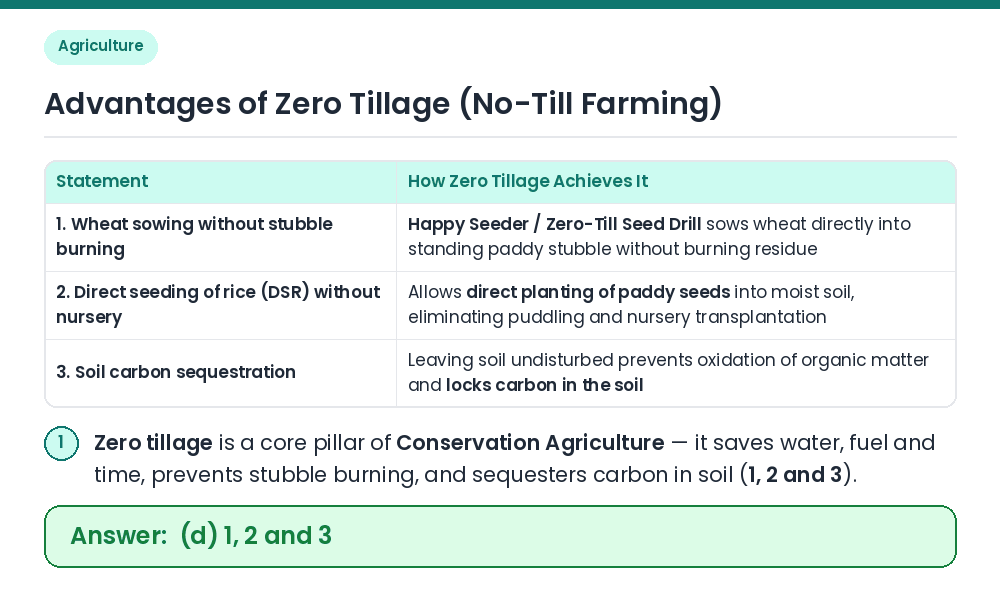
What is/are the advantage/advantages of zero tillage in agriculture? 1. Sowing of wheat is possible without burning the residue of previous crop. 2. Without the need for nursery of rice saplings, direct planting of paddy seeds in the wet soil is possible. 3. Carbon sequestration in the soil is possible. Select the correct answer using the code given below :
Show answer & explanationShow explanation
Answer: (D) 1, 2 and 3
Given / Concept: Agronomic and environmental benefits of Zero Tillage (No-Till farming) in the rice–wheat cropping system. Statements 1 & 2: Using zero-till seed drills or Happy Seeders, farmers can sow wheat seeds directly into fields covered with paddy residue without ploughing or burning stubble (⇒ Statement 1 is correct); similarly, zero-till Direct Seeded Rice (DSR) enables direct sowing of paddy seeds into moist soil without raising a nursery or puddling (⇒ Statement 2 is correct). Statement 3: Conventional ploughing exposes soil organic matter to air, oxidising it into CO₂; zero tillage leaves crop residues on the surface and keeps soil carbon locked underground, enhancing soil carbon sequestration (⇒ Statement 3 is correct). Result: All three statements (1, 2 and 3) are advantages of zero tillage. Related Facts: • Three Principles of Conservation Agriculture (FAO): (1) Minimum mechanical soil disturbance (Zero/minimum tillage), (2) Permanent soil organic cover (mulch/crop residue), and (3) Species diversification (crop rotation). • Additional Benefits: Saves 20%–30% irrigation water, reduces diesel consumption in tractors, and prevents soil erosion. Correct Answer: (d) 1, 2 and 3