Civil Services Examination · Question 85
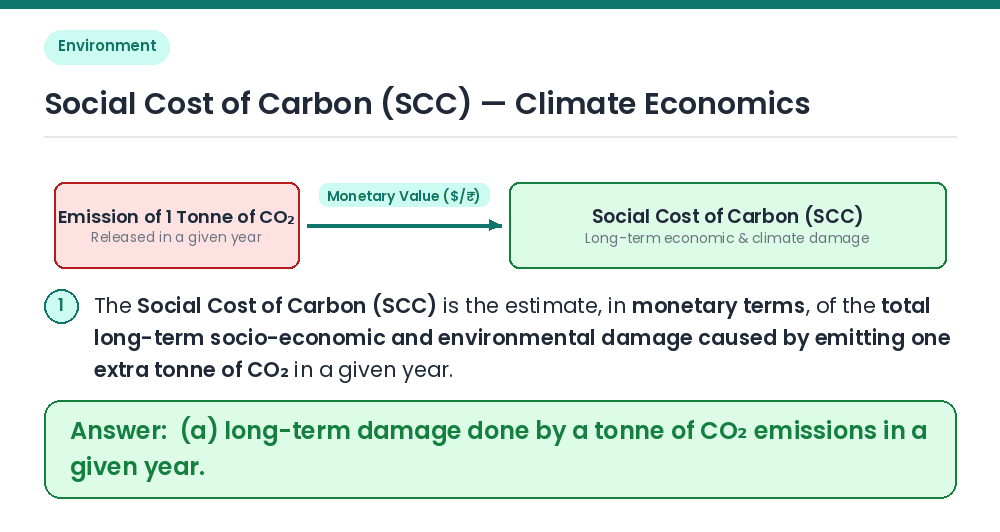
Which one of the following statements best describes the term 'Social Cost of Carbon'? It is a measure, in monetary value, of the
Show answer & explanationShow explanation
Answer: (A) long-term damage done by a tonne of CO₂ emissions in a given year.
Given / Concept: Definition of the 'Social Cost of Carbon' (SCC) in environmental and climate change economics. Define SCC: The Social Cost of Carbon quantifies in monetary units (e.g., US Dollars per tonne of CO₂) the present discounted value of all future economic damages—such as reduced agricultural productivity, human health impacts, property loss from sea-level rise, and extreme weather—caused by emitting one additional metric tonne of carbon dioxide in a given year. Policy Use: Governments and economists use the SCC to conduct cost-benefit analyses of climate regulations and to set optimal carbon taxes. Result: It is a measure, in monetary value, of the long-term damage done by a tonne of CO₂ emissions in a given year. Related Facts: • Nobel Prize 2018 (Economics): Awarded to William Nordhaus for integrating climate change into long-run macroeconomic analysis (DICE model, used to calculate the Social Cost of Carbon). • Country-Level SCC: A 2018 study in Nature estimated that India experiences the highest country-level social cost of carbon (~$86 per tonne of CO₂) due to high population and agricultural sensitivity. Correct Answer: (a) long-term damage done by a tonne of CO₂ emissions in a given year.