Civil Services Examination · Question 41
Read the following passage and answer the item that follows. Your answer to this item should be based on the passage only. Passage – 1 Nothing can exist in a natural state which can be called good or bad by common assent, since every man who is in a natural state consults only his own advantage, and determines what is good or bad according to his own fancy and insofar as he has regard for his own advantage alone, and holds himself responsible to no one save himself by any law; and therefore sin cannot be conceived in a natural state, but only in a civil state, which is decreed by common consent what is good or bad, and each one holds himself responsible to the state. Which one of the following statements best reflects the central idea of the passage given above?
Show answer & explanationShow explanation
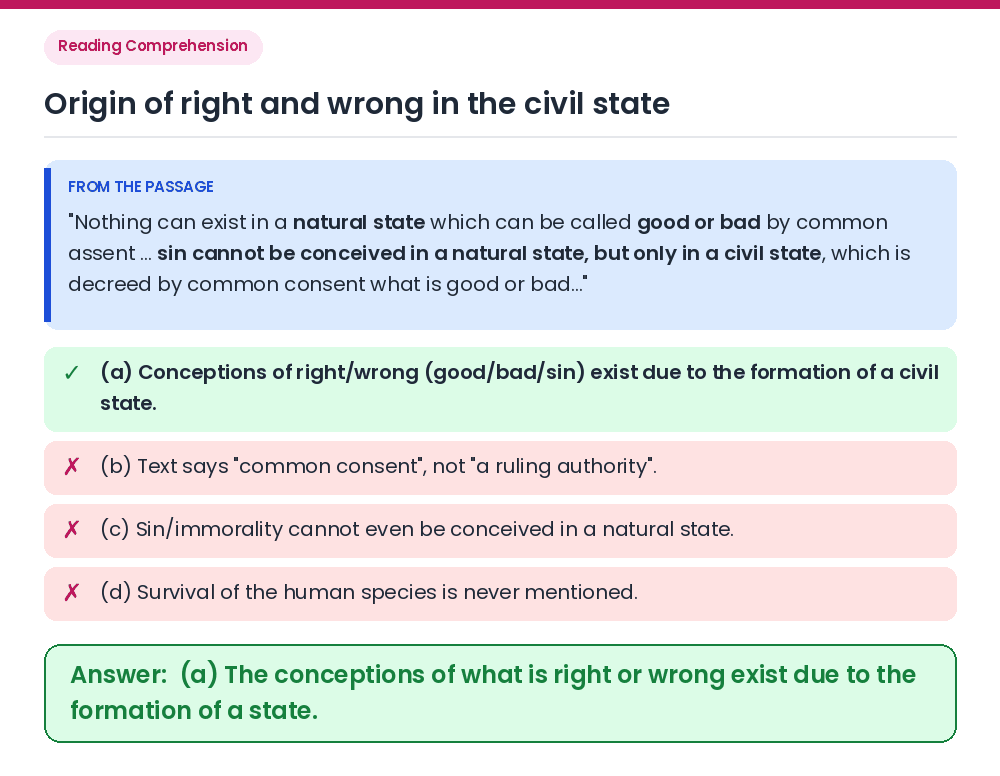
Answer: (A) The conceptions of what is right or wrong exist due to the formation of a state.
Given / Concept: In a natural state, nothing can be called good or bad by common assent and sin cannot be conceived; only in a civil state is good or bad decreed by common consent. Compare Options: Option (a) directly captures this contrast — shared conceptions of right and wrong (sin/good/bad) arise only through the formation of a civil state. Elimination: The passage says good/bad in a civil state is decreed "by common consent" (not a single ruling authority, eliminating b); since sin cannot even be conceived in a natural state, calling natural man "immoral" is self-contradictory (eliminating c); survival of the species is not mentioned (eliminating d). Result: Statement (a) best reflects the central idea. Correct Answer: (a) The conceptions of what is right or wrong exist due to the formation of a state.