Civil Services Examination · Question 10
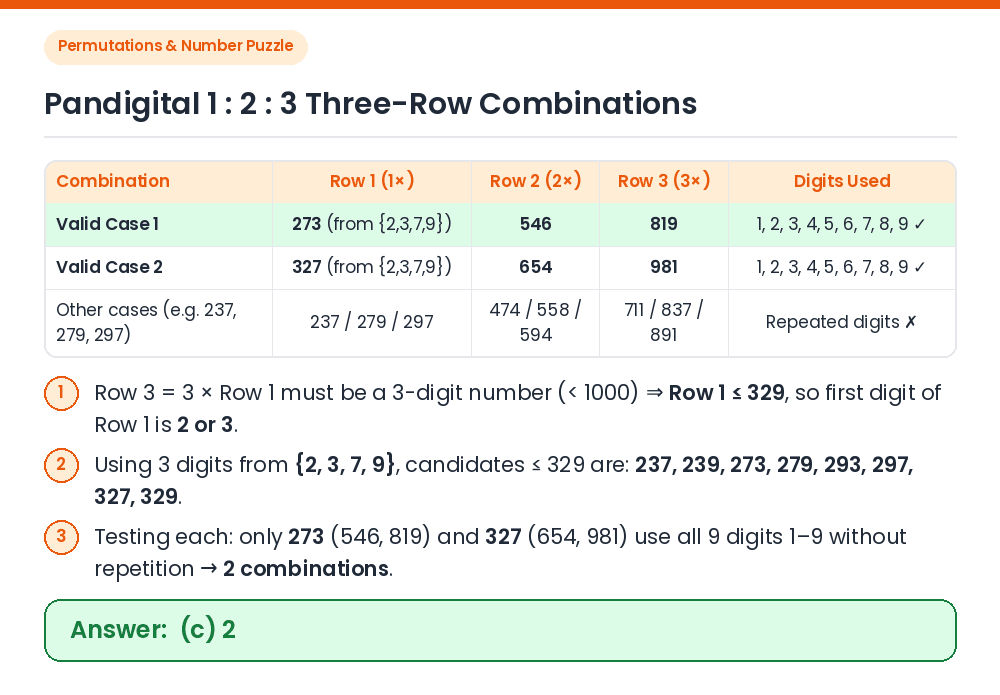
The digits 1 to 9 are arranged in three rows in such a way that each row contains three digits, and the number formed in the second row is twice the number formed in the first row; and the number formed in the third row is thrice the number formed in the first row. Repetition of digits is not allowed. If only three of the four digits 2, 3, 7 and 9 are allowed to use in the first row, how many such combinations are possible to be arranged in the three rows?
Show answer & explanationShow explanation
Answer: (C) 2
Given: Let the 3-digit number in Row 1 be N. Then Row 2 = 2N and Row 3 = 3N, using all digits 1 to 9 exactly once. N is formed from 3 of {2, 3, 7, 9}. Bound on N: Since 3N < 1000, N ≤ 333. With digits from {2, 3, 7, 9}, the hundreds digit of N can only be 2 or 3, and if it is 3, the tens digit must be 2. List Candidates for N: The possible values of N ≤ 329 are 237, 239, 273, 279, 293, 297, 327, 329. Check Digit Repetition: ⇒ N = 273: 2N = 546, 3N = 819 (uses {2,7,3,5,4,6,8,1,9} — all 9 digits distinct ✓) ⇒ N = 327: 2N = 654, 3N = 981 (uses {3,2,7,6,5,4,9,8,1} — all 9 digits distinct ✓) All other candidates repeat digits (e.g., 2×237 = 474 repeats 4 and 7; 2×279 = 558 repeats 5). Result: Exactly 2 such combinations are possible. Correct Answer: (c) 2