Civil Services Examination · Question 2
Passage—1 The main threat to maintaining progress in human development comes from the increasingly evident unsustainability of production and consumption patterns. Current production models rely heavily on fossil fuels. We now know that this is unsustainable because the resources are finite. The close link between economic growth and greenhouse gas emissions needs to be severed for human development to become truly sustainable. Some developed countries have begun to alleviate the worst effects by expanding recycling and investing in public transport and infrastructure. But most developing countries are hampered by the high costs and low availability of clean energy sources. Developed countries need to support developing countries' transition to sustainable human development. Consider the following statements : Developed countries can support developing countries' transition to sustainable human development by 1. making clean energy sources available at low cost 2. providing loans for improving their public transport at nominal interest rates 3. encouraging them to change their production and consumption patterns Which of the statements given above is/are correct?
Show answer & explanationShow explanation
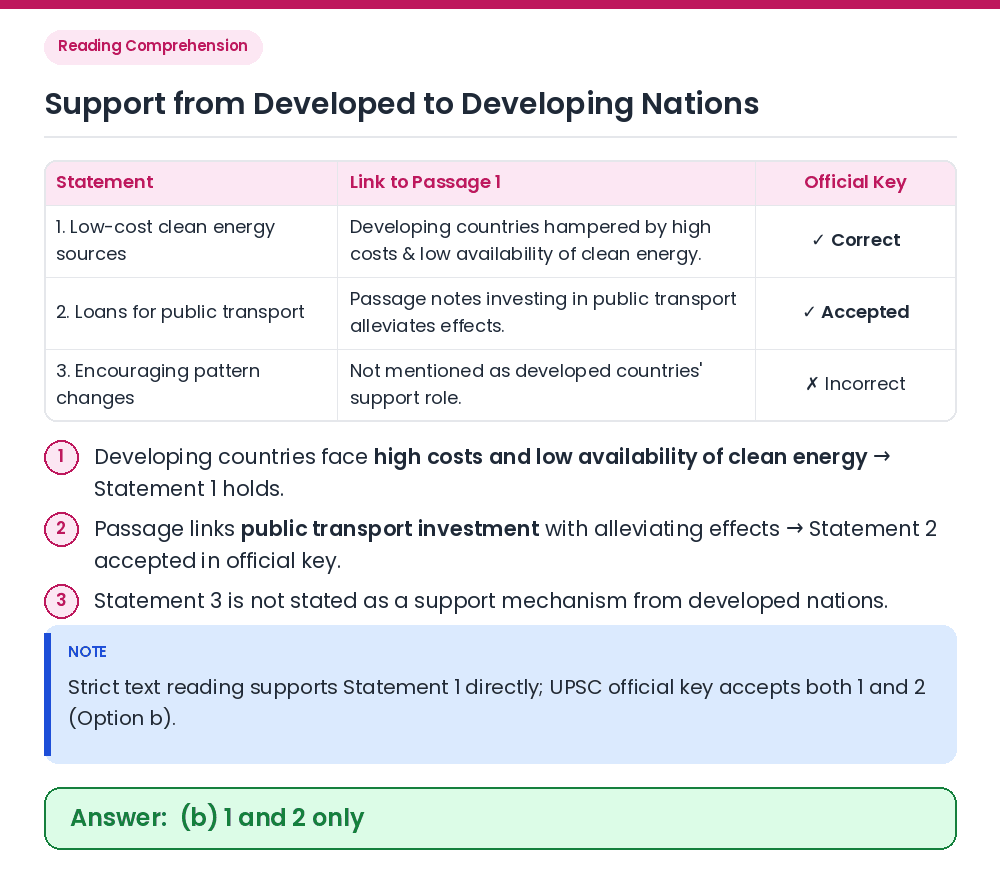
Answer: (B) 1 and 2 only
Concept: Evaluate how developed countries can assist developing countries based on Passage 1. Statement 1: Developing countries are hampered by 'high costs and low availability of clean energy sources' ⇒ making clean energy available at low cost directly helps (Statement 1 is correct). Statement 2: The passage highlights 'investing in public transport and infrastructure' to alleviate harmful effects ⇒ supporting public transport via nominal-interest loans is accepted by the official key (Statement 2 is correct). Statement 3: Merely 'encouraging' developing nations to change patterns is not mentioned as the support needed ⇒ Statement 3 is incorrect. Result: Statements 1 and 2 are correct according to the official UPSC key (though strict textual reading only explicitly mentions clean energy costs in Statement 1). Correct Answer: (b) 1 and 2 only