Civil Services Examination · Question 5
An Identity Card has the number ABCDEFG, not necessarily in that order, where each letter represents a distinct digit (1, 2, 4, 5, 7, 8, 9 only). The number is divisible by 9. After deleting the first digit from the right, the resulting number is divisible by 6. After deleting two digits from the right of original number, the resulting number is divisible by 5. After deleting three digits from the right of original number, the resulting number is divisible by 4. After deleting four digits from the right of original number, the resulting number is divisible by 3. After deleting five digits from the right of original number, the resulting number is divisible by 2. Which of the following is a possible value for the sum of the middle three digits of the number?
Show answer & explanationShow explanation
Answer: (A) 8
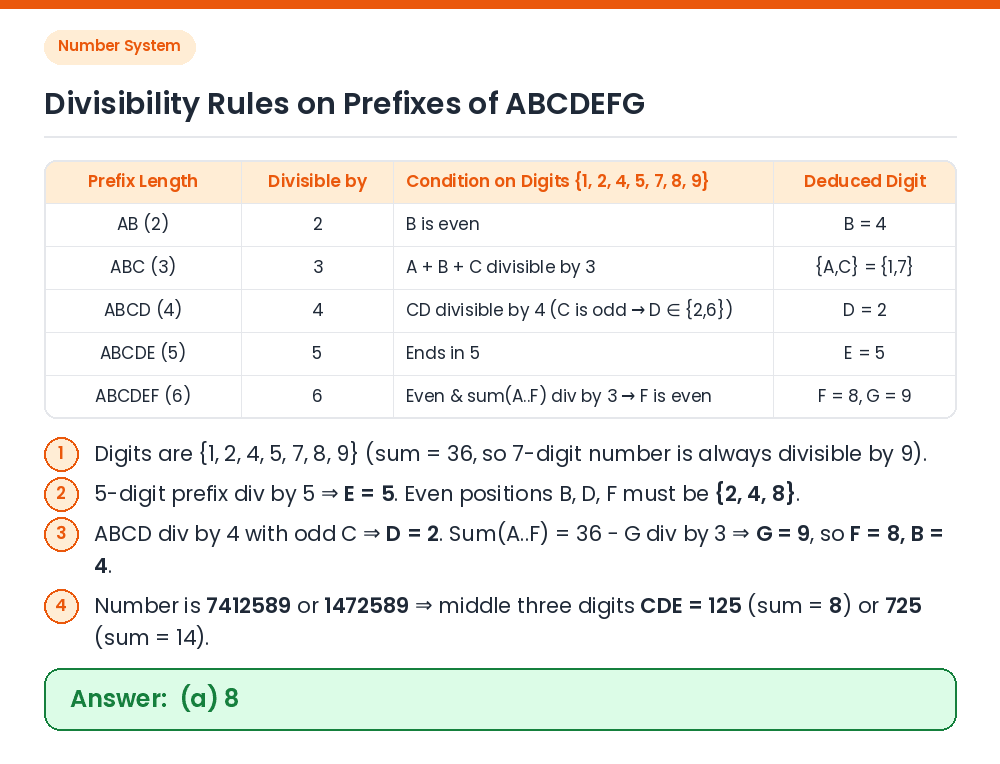
Given: Available digits are {1, 2, 4, 5, 7, 8, 9} (sum = 36, divisible by 9). Prefixes AB, ABC, ABCD, ABCDE, ABCDEF are divisible by 2, 3, 4, 5, 6 respectively. Find E and Even Digits: ABCDE is divisible by 5 ⇒ E = 5. Since AB, ABCD, and ABCDEF are even, B, D, F must be the three even digits {2, 4, 8}, leaving {1, 7, 9} for A, C, G. Find G, D, B, F: ABC is divisible by 3 and ABCDEF is divisible by 6 (so divisible by 3) ⇒ D + E + F is divisible by 3, and G = 36 − (A+B+C+D+E+F) must be divisible by 3 ⇒ G = 9. Thus {A, C} = {1, 7} (both odd). For ABCD to be divisible by 4 when C is odd, D must be 2 (since 12 and 72 are divisible by 4, whereas 4 and 8 fail). Then D + E + F = 2 + 5 + F = 7 + F is divisible by 3 ⇒ F = 8, leaving B = 4. Middle Three Digits CDE: Valid numbers are 7412589 (CDE = 1, 2, 5 ⇒ sum = 8) and 1472589 (CDE = 7, 2, 5 ⇒ sum = 14). Result: From the given options, the possible sum of the middle three digits (C + D + E) is 8. Correct Answer: (a) 8