Civil Services Examination · Question 44
Passage—2 The demographic dividend, which has begun in India and is expected to last another few decades, is a great window of opportunity. The demographic dividend is basically a swelling in the working age population, which conversely means that the relative ratio of very young and very old will, for a while, be on the decline. From the experience of Ireland and China, we know that this can be a source of energy and an engine of economic growth. The demographic dividend tends to raise a nation's savings rate since in any nation, it is the working age population that is the main saver. And since the savings rate is an important driver of growth, this should help elevate our growth rate. However, the benefits of demographic dividend depend on the quality of the working age population. And this implies bringing back the importance of education, acquisition of skills and human capital. With reference to the passage, which of the following inferences can be drawn? 1. Demographic dividend is an essential condition for a country to rapidly increase its economic growth rate. 2. Promotion of higher education is an essential condition for a country for its rapid economic growth. Select the correct answer using the code given below.
Show answer & explanationShow explanation
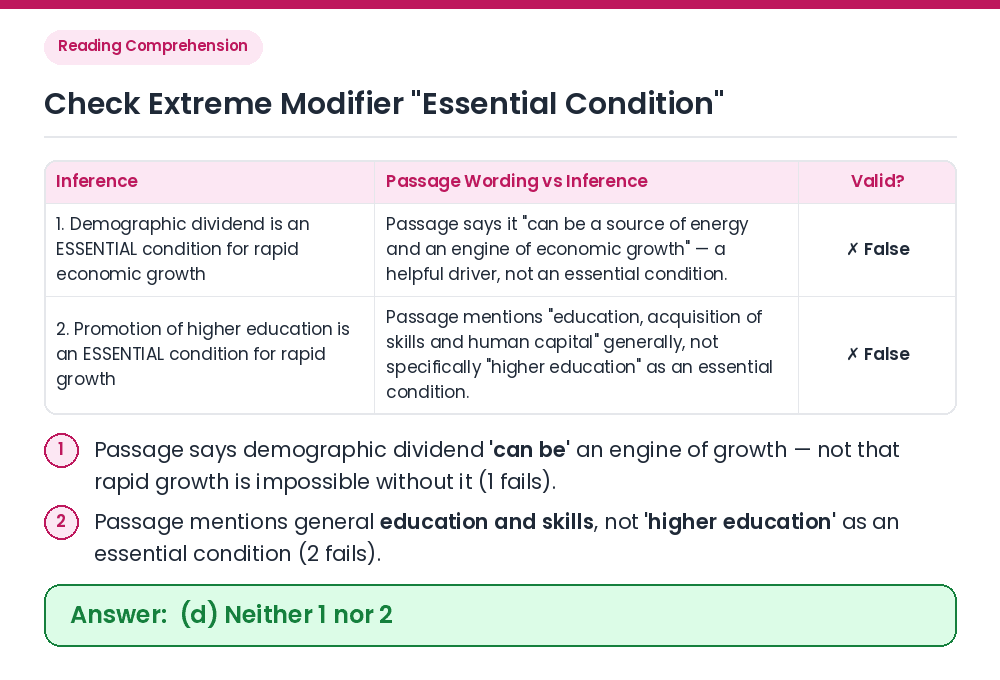
Answer: (D) Neither 1 nor 2
Concept: Check whether the passage supports the strict logical claim of an 'essential (necessary) condition' in Statements 1 and 2. Check Statement 1: The passage says demographic dividend 'can be a source of energy and an engine of economic growth' and 'should help elevate our growth rate'. Helping elevate growth does not make it an essential condition without which rapid growth cannot occur ⇒ Statement 1 is invalid. Check Statement 2: The passage mentions 'education, acquisition of skills and human capital' broadly to realize the demographic dividend, never singling out 'higher education' as an essential condition for rapid economic growth ⇒ Statement 2 is invalid. Result: Neither 1 nor 2 can be validly inferred. Correct Answer: (d) Neither 1 nor 2