Civil Services Examination · Question 31
Directions: Read the following passage and answer the item that follows the passage. Your answer to this item should be based on the passage only. Passage – 1 In India, the segregation of municipal waste at source is rare. Recycling is mostly with the informal sector. More than three-fourths of the municipal budget goes into collection and transportation, which leaves very little for processing/resource recovery and disposal. Where does waste-to-energy fit into all this? Ideally it fits in the chain after segregation (between wet waste and the rest), collection, recycling, and before getting to the landfill. Which technology is most appropriate in converting waste to energy depends on what is in the waste (that is biodegradable versus non-biodegradable component) and its calorific value. The biodegradable component of India's municipal solid waste is a little over 50 per cent, and biomethanation offers a major solution for processing this. Based on the above passage, the following assumptions have been made: 1. Collection, processing and segregation of municipal waste should be with government agencies. 2. Resource recovery and recycling require technological inputs that can be best handled by private sector enterprises. Which of the assumptions given above is/are correct?
Show answer & explanationShow explanation
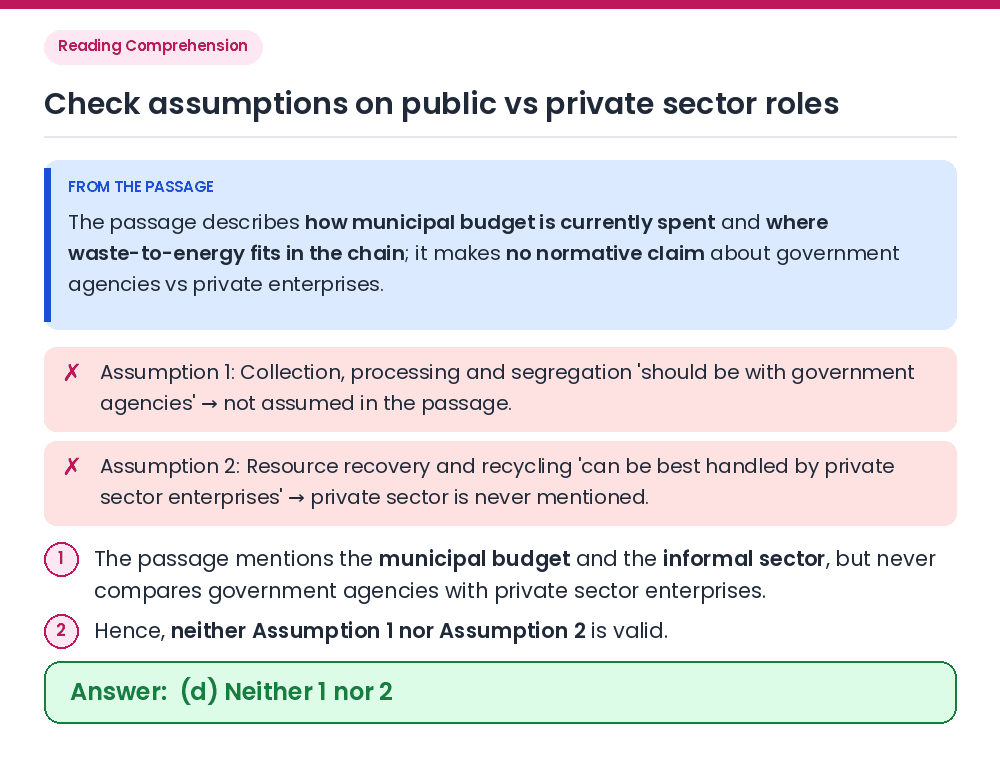
Answer: (D) Neither 1 nor 2
Core Idea: The passage discusses the waste management chain (segregation, collection, recycling, waste-to-energy) and notes that recycling is mostly in the informal sector. Evaluate Assumption 1: The passage does not state or assume that segregation and processing must be exclusively with government agencies ⇒ Assumption 1 is invalid. Evaluate Assumption 2: Private sector enterprises are nowhere mentioned or implied as the best handlers of recycling ⇒ Assumption 2 is invalid. Result: Neither Assumption 1 nor Assumption 2 is correct. Correct Answer: (d) Neither 1 nor 2