Civil Services Examination · Question 32
Directions: Read the following passage and answer the item that follows the passage. Your answer to this item should be based on the passage only. Passage – 1 In India, the segregation of municipal waste at source is rare. Recycling is mostly with the informal sector. More than three-fourths of the municipal budget goes into collection and transportation, which leaves very little for processing/resource recovery and disposal. Where does waste-to-energy fit into all this? Ideally it fits in the chain after segregation (between wet waste and the rest), collection, recycling, and before getting to the landfill. Which technology is most appropriate in converting waste to energy depends on what is in the waste (that is biodegradable versus non-biodegradable component) and its calorific value. The biodegradable component of India's municipal solid waste is a little over 50 per cent, and biomethanation offers a major solution for processing this. Which one of the following statements best reflects the crux of the passage?
Show answer & explanationShow explanation
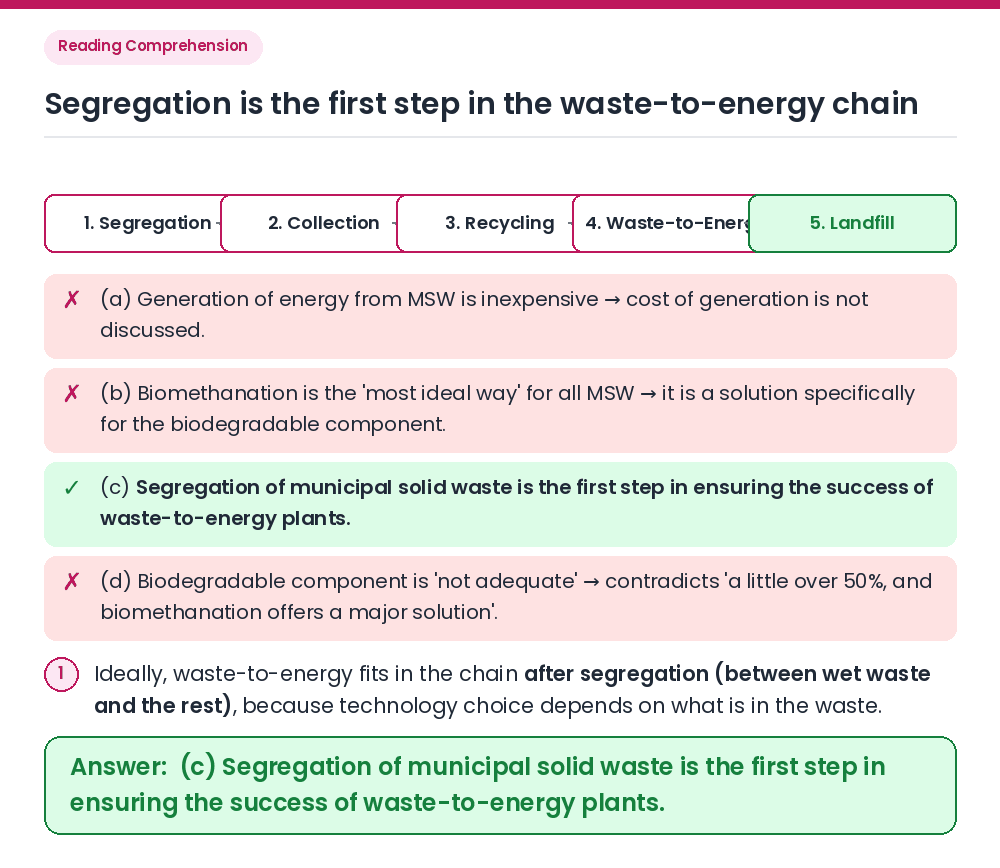
Answer: (C) Segregation of municipal solid waste is the first step in ensuring the success of waste-to-energy plants.
Core Idea: The passage explains that waste-to-energy fits into the chain after segregation, and choosing the right technology depends on separating biodegradable from non-biodegradable waste. Evaluate Option c: Since segregation at source is rare in India yet essential before waste-to-energy processing, segregation is the first step for waste-to-energy success. Eliminate Other Options: Cost (a) is not mentioned; (b) overgeneralizes biomethanation to all MSW; (d) contradicts the text ('biomethanation offers a major solution'). Result: Statement (c) best reflects the crux of the passage. Correct Answer: (c) Segregation of municipal solid waste is the first step in ensuring the success of waste-to-energy plants.