Civil Services Examination · Question 21
Passage—1 By the time children reach class 8, the bulk of them tend to be in the age range of 13 years to 15 years. But in our country, about a quarter of all children in class 8 struggle with reading simple texts and more than half are still unable to do basic arithmetic operations like division. Every year about 25 million young boys and girls from elementary school move into the life that lies for them beyond compulsory schooling. They cannot enter the workforce at least in the organized sector till they are 18. For many families, these children are the first from their families ever to get this far in school. Parents and children expect that such 'graduates' from school will go on to high school and college. Hardly anyone wants to go back to agriculture. On the other hand, abilities in terms of academic competencies are far lower than they should be even based on curricular expectations of class 8. Based on the above passage, the following assumptions have been made : 1. For effective school education, parents have greater role than the governments. 2. School curriculum that conforms to today's requirements and is uniform for the entire country may address the issues brought out. Which of the assumptions given above is/are valid?
Show answer & explanationShow explanation
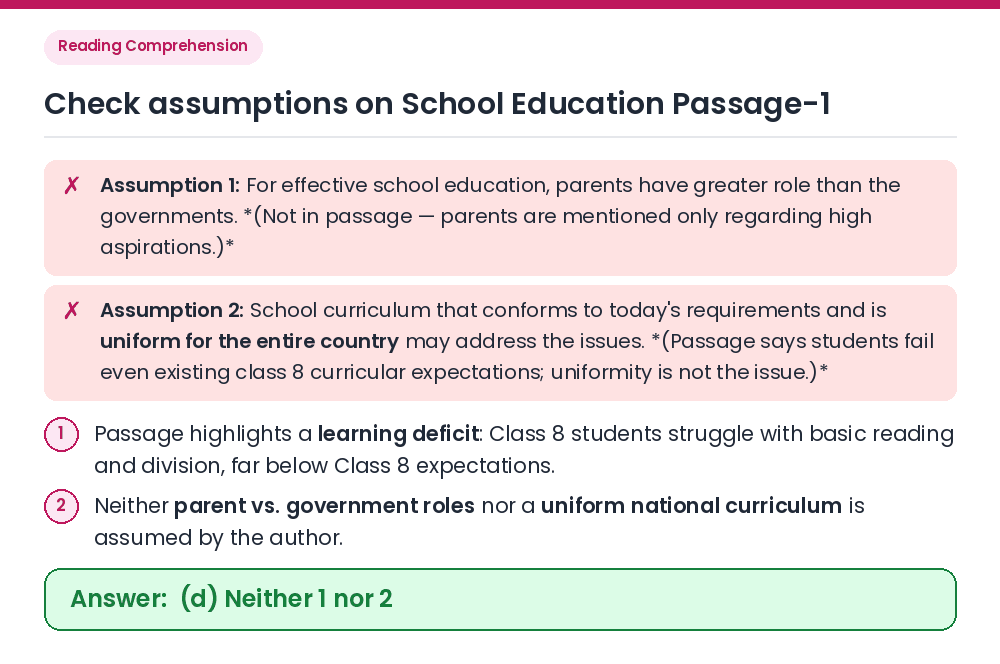
Answer: (D) Neither 1 nor 2
Given / Concept: Check whether the passage relies on either statement as an unstated premise. Evaluate Assumption 1: The passage only states that parents expect their children to go to high school and college; it never compares the role of parents with that of governments ⇒ Assumption 1 is invalid. Evaluate Assumption 2: The passage states that children's competencies are far lower than 'even based on curricular expectations of class 8' (the problem is poor learning outcomes, not the lack of a uniform curriculum) ⇒ Assumption 2 is invalid. Result: Neither assumption 1 nor 2 is valid. Correct Answer: (d) Neither 1 nor 2