Civil Services Examination · Question 22
Passage—1 By the time children reach class 8, the bulk of them tend to be in the age range of 13 years to 15 years. But in our country, about a quarter of all children in class 8 struggle with reading simple texts and more than half are still unable to do basic arithmetic operations like division. Every year about 25 million young boys and girls from elementary school move into the life that lies for them beyond compulsory schooling. They cannot enter the workforce at least in the organized sector till they are 18. For many families, these children are the first from their families ever to get this far in school. Parents and children expect that such 'graduates' from school will go on to high school and college. Hardly anyone wants to go back to agriculture. On the other hand, abilities in terms of academic competencies are far lower than they should be even based on curricular expectations of class 8. Which one of the following statements best reflects the central idea conveyed by the passage?
Show answer & explanationShow explanation
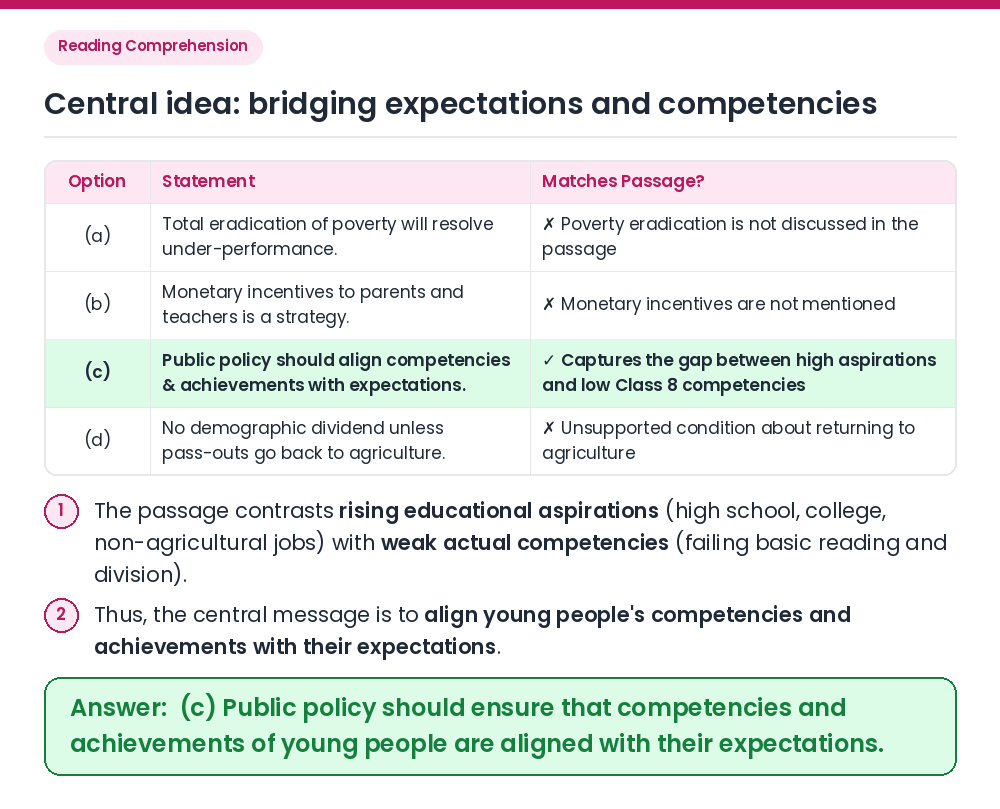
Answer: (C) Public policy should ensure that competencies and achievements of young people are aligned with their expectations.
Given / Concept: The passage highlights a mismatch between high expectations (going to high school/college, leaving agriculture) and low academic competencies in Class 8. Eliminate Extraneous Options: (a) poverty eradication, (b) monetary incentives, and (d) forcing pass-outs back into agriculture for demographic dividend go beyond or distort the passage. Verify Option c: Bridging the gap between young people's actual competencies/achievements and their aspirations directly addresses the core problem described. Result: Option (c) best reflects the central idea. Correct Answer: (c) Public policy should ensure that competencies and achievements of young people are aligned with their expectations.