Civil Services Examination · Question 67
A Question is given followed by two Statements I and II. Consider the Question and the Statements. There are three distinct prime numbers whose sum is a prime number. Question : What are those three numbers? Statement-I : Their sum is less than 23. Statement-II : One of the numbers is 5. Which one of the following is correct in respect of the above Question and the Statements?
Show answer & explanationShow explanation
Answer: (A) The Question can be answered by using one of the Statements alone, but cannot be answered using the other Statement alone
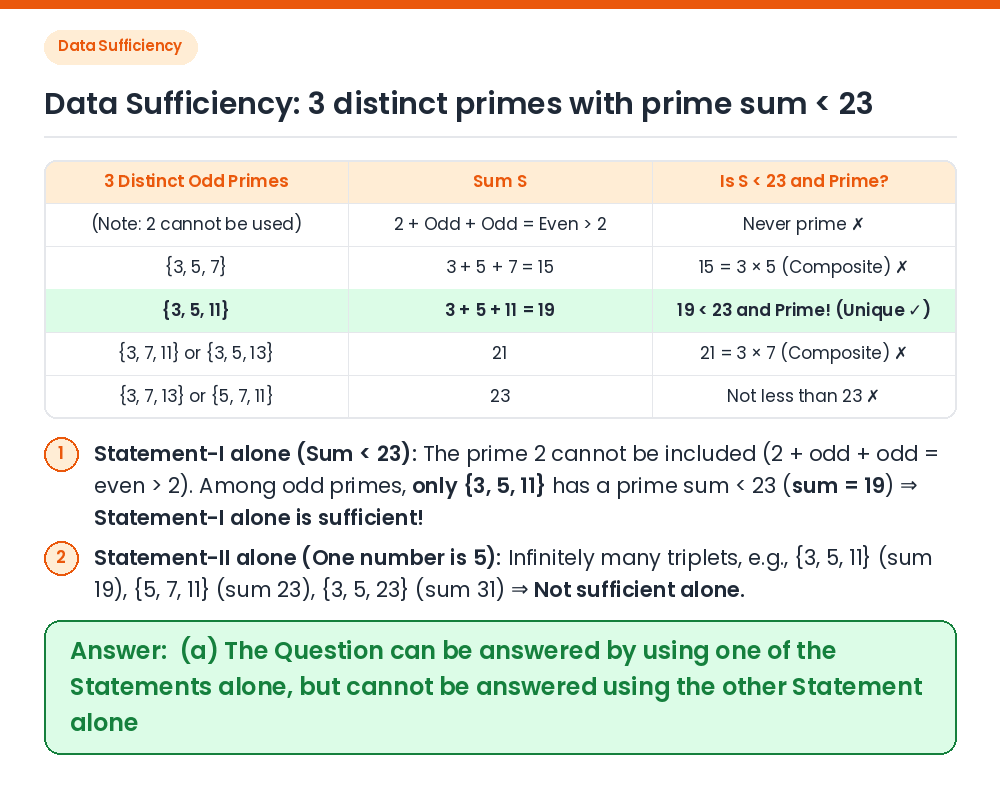
Given / Concept: Three distinct primes p < q < r have a prime sum S. Note that p cannot be 2, because 2 + odd + odd = even > 2 (never prime). Thus all three primes are odd. Check Statement-I Alone — S < 23: Test the smallest triplets of odd primes with sum < 23: ⇒ 3 + 5 + 7 = 15 (not prime) ⇒ 3 + 5 + 11 = 19 (prime, and 19 < 23!) ⇒ 3 + 7 + 11 = 21 (not prime); 3 + 5 + 13 = 21 (not prime); all other triplets have sum ≥ 23. ⇒ Statement-I ALONE uniquely determines the three numbers as 3, 5, and 11! Check Statement-II Alone: Knowing one number is 5 allows many triplets, e.g., (3, 5, 11) with sum 19, (5, 7, 11) with sum 23, (3, 5, 23) with sum 31 ⇒ Not sufficient alone. Result: The question can be answered by using one of the statements (Statement-I) alone, but not the other. Correct Answer: (a) The Question can be answered by using one of the Statements alone, but cannot be answered using the other Statement alone