Civil Services Examination · Question 73
A Question is given followed by two Statements I and II. Consider the Question and the Statements. Age of each of P and Q is less than 100 years but more than 10 years. If you interchange the digits of the age of P, the number represents the age of Q. Question : What is the difference of their ages? Statement-I : The age of P is greater than the age of Q. Statement-II : The sum of their ages is 11/6 times their difference. Which one of the following is correct in respect of the above Question and the Statements?
Show answer & explanationShow explanation
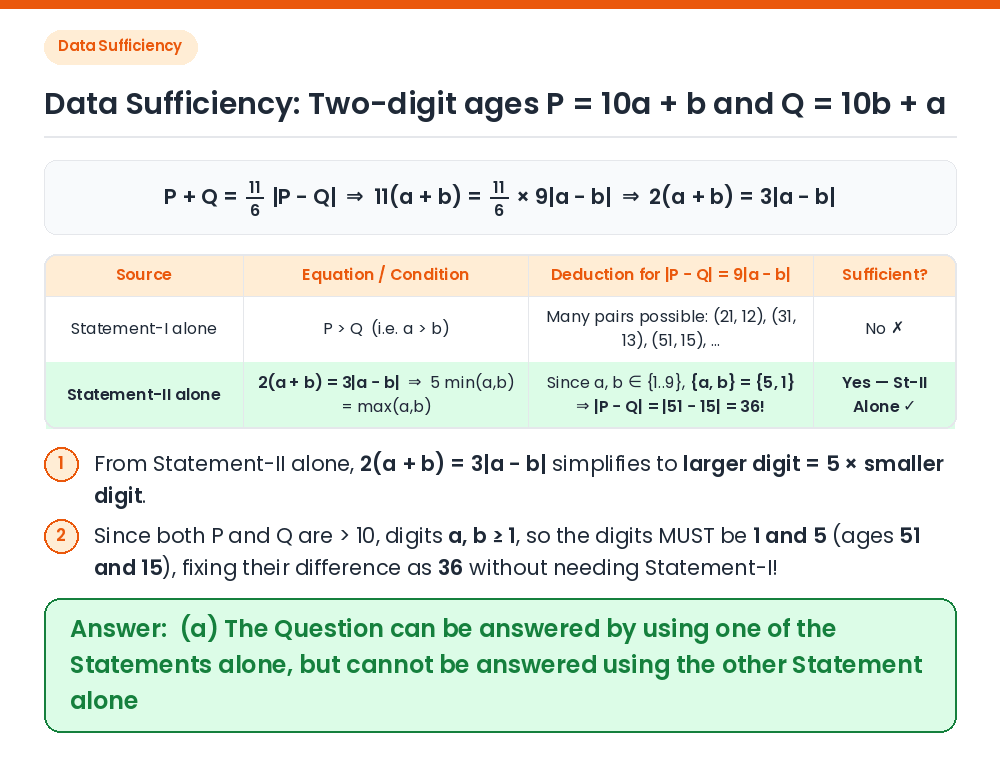
Answer: (A) The Question can be answered by using one of the Statements alone, but cannot be answered using the other Statement alone
Given / Concept: Let P = 10a + b and Q = 10b + a, where a, b ∈ {1, 2, …, 9} (since both ages are between 10 and 100). We need the age difference |P − Q| = 9|a − b|. Check Statement-I Alone: P > Q only tells us a > b, leaving many possible age differences (9, 18, 27, 36, …) ⇒ Not sufficient alone. Check Statement-II Alone: P + Q = (11/6)|P − Q| ⇒ 11(a + b) = (11/6) × 9|a − b| ⇒ 2(a + b) = 3|a − b|. ⇒ Whether a > b (giving a = 5b) or b > a (giving b = 5a), since a, b ∈ {1..9}, the two digits MUST be 5 and 1 (i.e. ages are 51 and 15 in either order). ⇒ Age difference = |51 − 15| = 36 years! Thus Statement-II ALONE is sufficient. Result: The question can be answered by using one of the statements (Statement-II) alone, but not the other. Correct Answer: (a) The Question can be answered by using one of the Statements alone, but cannot be answered using the other Statement alone