Civil Services Examination · Question 71
Passage—1 Unlike religion and science, poetry does not posit or expect any belief in absolute truths. Those forces or individuals who claim to have absolute truths in their grasp tend to turn dictatorial and tyrannical. Truth usually does not admit any contradictions or imperfections. It is unitarian. It is, therefore, not of much use for poetry. Poetry abides by the plurality of life and existence. Perhaps poetry follows reality which is plural, anachronistic, full of contradictions. Against the tyranny of truth, poetry remains a partisan of democratic reality. Against the arrogance of power, wealth and hierarchy, poetry proposes both humility and defiance. Which one of the following statements best reflects the most logical and rational message conveyed by the above passage?
Show answer & explanationShow explanation
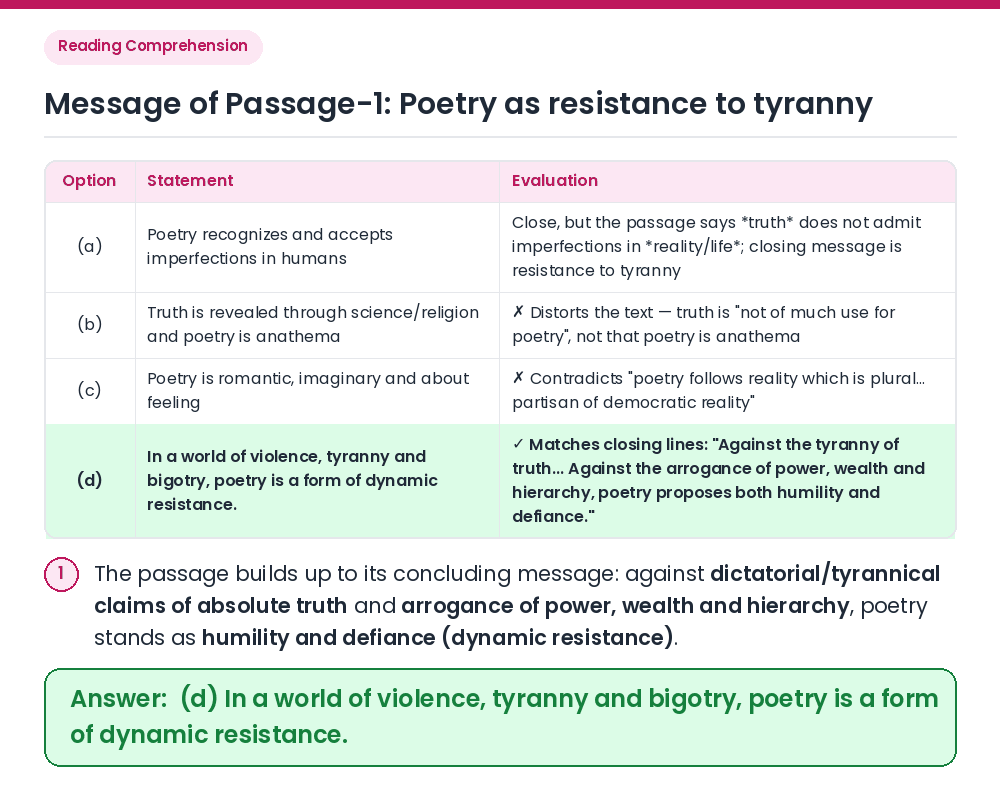
Answer: (D) In a world of violence, tyranny and bigotry, poetry is a form of dynamic resistance.
Given / Concept: Identify the core message conveyed by the passage's culmination. Analyze Concluding Lines: The passage states that claims of absolute truth turn 'dictatorial and tyrannical', and concludes: 'Against the tyranny of truth, poetry remains a partisan of democratic reality. Against the arrogance of power, wealth and hierarchy, poetry proposes both humility and defiance.' Compare Options: Options (b) and (c) distort the text. Option (a) narrows 'contradictions or imperfections' of plural reality to 'imperfections in humans', whereas Option (d) captures the overarching message of poetry as defiance/resistance against tyranny, dogmatism, and hierarchy. Result: Option (d) best reflects the message conveyed by the passage. Correct Answer: (d) In a world of violence, tyranny and bigotry, poetry is a form of dynamic resistance.