Civil Services Examination · Question 51
Read the following passage and answer the items that follow the passage. Your answers to these items should be based on the passage only. Passage – 1 It is hard to predict how changes in the climate and the atmosphere's chemistry will affect the prevalence and virulence of agricultural diseases. But there is a risk that such changes will make some plant infections more common in all climatic zones, perhaps catastrophically so. Part of the problem is that centuries of selective breeding have refined the genomes of most high-value crops. They are spectacular at growing in today's conditions but genetic variations that are not immediately useful to them have been bred out. This is good for yields but bad for coping with changes. A minor disease or even an unknown one could suddenly rampage through a genetically honed crop. Which one of the following statements best reflects the central idea conveyed by the passage ?
Show answer & explanationShow explanation
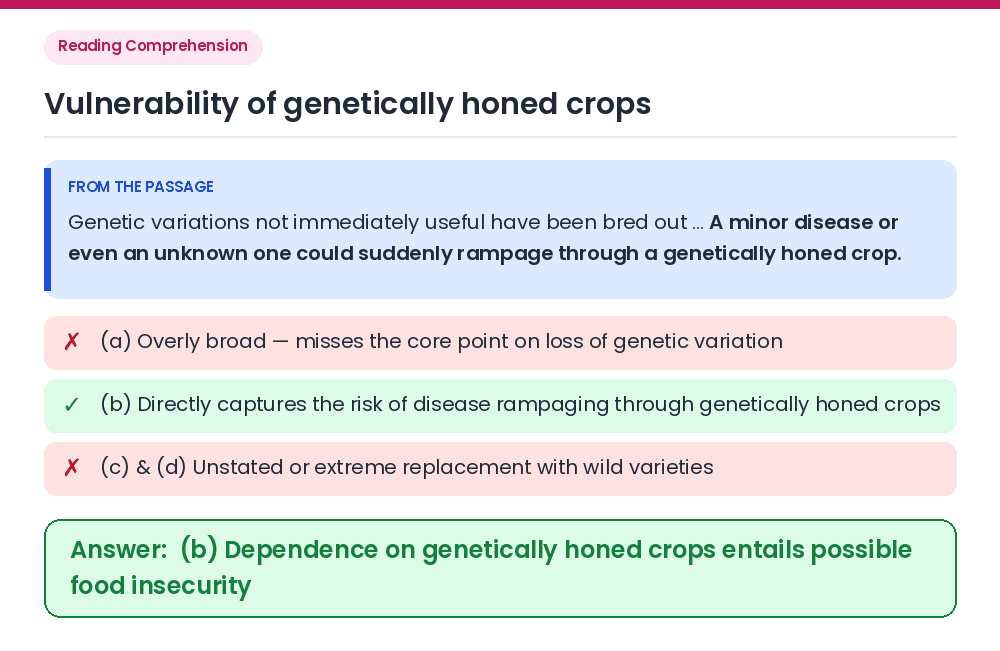
Answer: (B) Our total dependence on genetically honed crops entails possible food insecurity.
Concept: Identify the central vulnerability of selectively bred ('genetically honed') crops highlighted in Passage 1. Passage Analysis: Selective breeding has removed genetic variations needed to cope with climate/disease changes, so 'a minor disease or even an unknown one could suddenly rampage through a genetically honed crop.' Elimination: Option (a) is too general; (c) is vague; (d) demands total replacement with wild varieties (extreme). Result: Our total dependence on genetically honed crops entails possible food insecurity. Correct Answer: (b) Our total dependence on genetically honed crops entails possible food insecurity.