Civil Services Examination · Question 54
Read the following passage and answer the items that follow the passage. Your answers to these items should be based on the passage only. Passage – 2 “A good statesman, like any other sensible human being, learns more from his opponents than from his fervent supporters. For his supporters will push him to disaster unless his opponents show him where the dangers are. So if he is wise he will often pray to be delivered from his friends, because they will ruin him. But, though it hurts, he ought also to pray never to be left without opponents; for they keep him on the path of reason and good sense. The national unity of free people depends upon a sufficiently even balance of political power to make it impracticable for the administration to be arbitrary and for opposition to be revolutionary and irreconcilable.” With reference to the above passage, the following assumptions have been made : I. In a democracy, a strong opposition is required only if the Head of Government is indifferent. II. The more aggressive the opposition, the better is the governance in a democracy. Which of the above assumptions is/are valid ?
Show answer & explanationShow explanation
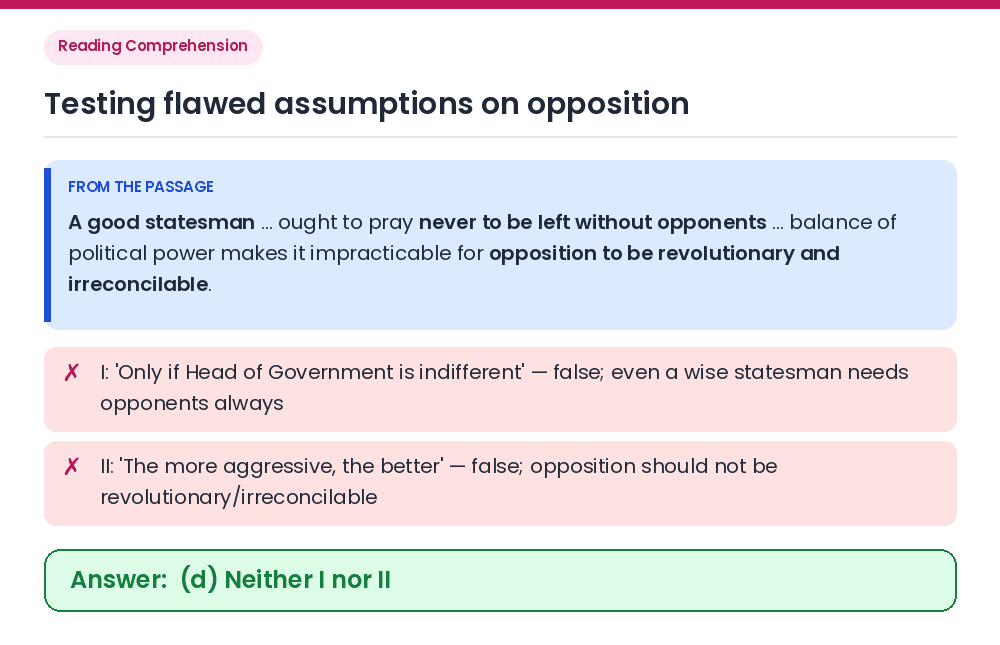
Answer: (D) Neither I nor II
Concept: Test both assumptions against the author's statements in Passage 2. Check Statement I: The passage says even 'a good statesman, like any other sensible human being' ought to pray 'never to be left without opponents'. Thus opposition is always needed, not 'only if the Head of Government is indifferent'. So I is invalid. Check Statement II: The final sentence warns against an opposition that is 'revolutionary and irreconcilable', advocating an 'even balance' rather than maximum aggression. So II is invalid. Result: Neither assumption I nor II is valid. Correct Answer: (d) Neither I nor II