Civil Services Examination · Question 26
Directions: Read the following passage and answer the item that follows. Your answer should be based solely on the passage. Passage: When SARS-CoV-2 was first detected in 2019, it was a truly novel virus for the world. At that time, no one in the world had been exposed to SARS-CoV-2 or had specific immunity against it. In contrast, people across the world have been exposed to HMPV for decades and the virus is well-studied. HMPV and SARS-CoV-2 belong to two very different virus families with fundamentally different characteristics and epidemiology, with strong seasonality seen in HMPV, unlike SARS-CoV-2. Both viruses cause different severity of symptoms, particularly over the long term, and the affected population segments do not fully overlap. In general, HMPV causes milder illness with deaths being very rare and with no long-term post-viral symptoms. Which of the following conclusions is/are valid? 1. Though SARS-CoV-2 and HMPV are similar viruses with somewhat different epidemiology, the former became a pandemic because it was novel and people had not been exposed to it in the past. 2. The two viruses have fundamentally different impacts on human populations and should not therefore be dealt with in a similar manner. Select the answer using the code given below.
Show answer & explanationShow explanation
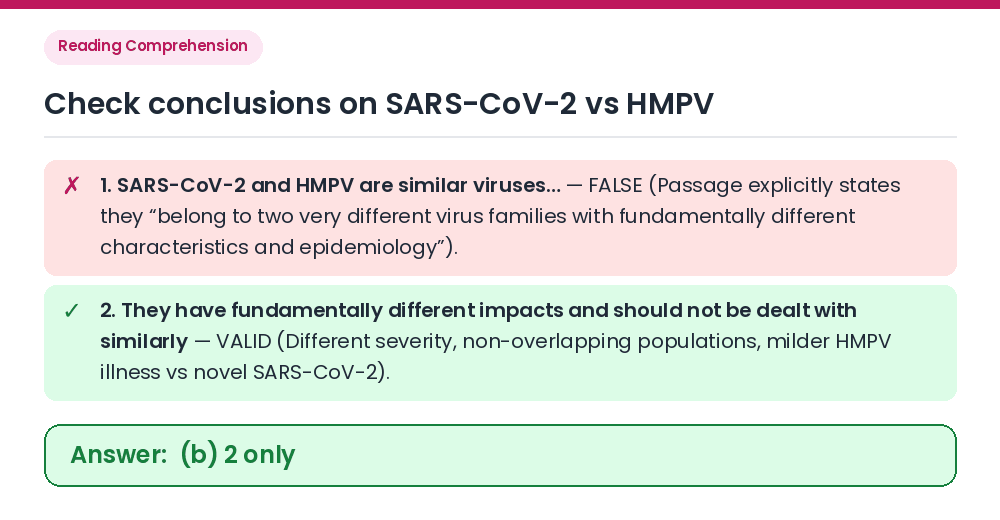
Answer: (B) 2 only
Given / Concept: Test each conclusion against the explicit comparison in the passage. Check Statement 1: Statement 1 calls them 'similar viruses with somewhat different epidemiology', directly contradicting the passage: 'HMPV and SARS-CoV-2 belong to two very different virus families with fundamentally different characteristics and epidemiology' ⇒ 1 is invalid. Check Statement 2: The passage highlights that they have prior-immunity differences, different symptom severity, non-overlapping affected groups, and no long-term post-viral symptoms in HMPV ⇒ they have fundamentally different impacts and should not be dealt with identically ⇒ 2 is valid. Result: Only conclusion 2 is valid. Correct Answer: (b) 2 only