Civil Services Examination · Question 1
Directions: This item contains a question followed by two statements. Answer the item using the following instructions: (a) Select this option if the question can be answered using one of these statements alone, but cannot be answered using the other statement. (b) Select this option if the question can be answered using either statement alone. (c) Select this option if the question can be answered using both the statements together, but cannot be answered using either statement alone. (d) Select this option if the question cannot be answered even using any of the statements. Question: X receives three coins of different denominations : 1, 2, 5, 10 and 20. If the total amount received by X is m, does X receive a coin of denomination 5? Statement I: m is not a prime number. Statement II: The sum of the digits of m is greater than 5.
Show answer & explanationShow explanation
Answer: (A) Can be answered using one of the statements alone, but not the other
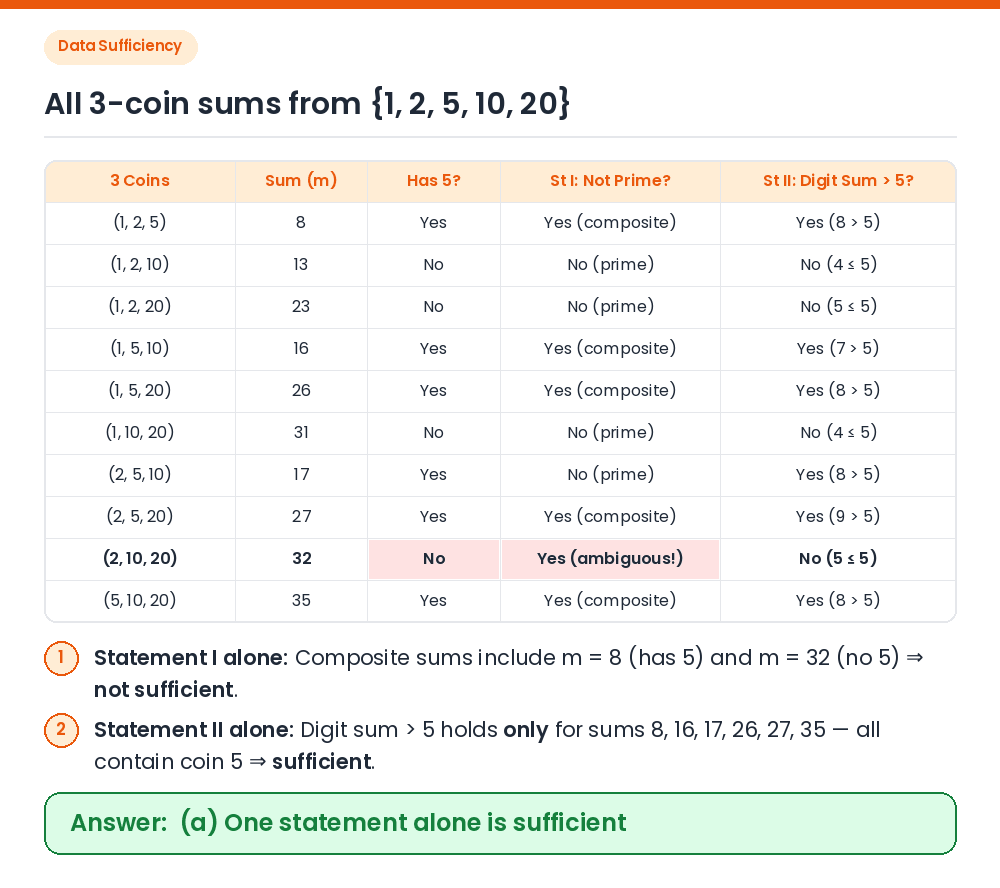
Given / Concept: X picks 3 distinct coins from {1, 2, 5, 10, 20}, giving C(5,3) = 10 possible sums m. Without coin 5: Sums from {1, 2, 10, 20} are 1+2+10 = 13, 1+2+20 = 23, 1+10+20 = 31, and 2+10+20 = 32. With coin 5: Sums containing 5 are 8, 16, 17, 26, 27, and 35. Check Statement I: If m is not prime, m can be 8 (contains 5) or 32 (does not contain 5) ⇒ Statement I alone is not sufficient. Check Statement II: Sums without 5 have digit sums 4, 5, 4, 5 (all ≤ 5), while sums with 5 have digit sums 8, 7, 8, 8, 9, 8 (all > 5) ⇒ Statement II alone guarantees X received coin 5. Result: Only Statement II alone is sufficient, so option (a) is correct. Shortcut: Check the 4 sums without coin 5 (13, 23, 31, 32) — none has digit sum > 5, whereas 32 is composite. Correct Answer: (a) Can be answered using one of the statements alone, but not the other