Civil Services Examination · Question 5
Directions: This item contains a question followed by two statements. Answer the item using the following instructions: (a) Select this option if the question can be answered using one of these statements alone, but cannot be answered using the other statement. (b) Select this option if the question can be answered using either statement alone. (c) Select this option if the question can be answered using both the statements together, but cannot be answered using either statement alone. (d) Select this option if the question cannot be answered even using any of the statements. Question: If x, y and z are integers, each greater than 1, then is x a prime number? Statement I: xy² = 116 Statement II: xz = 261
Show answer & explanationShow explanation
Answer: (A) Can be answered using one of the statements alone, but not the other
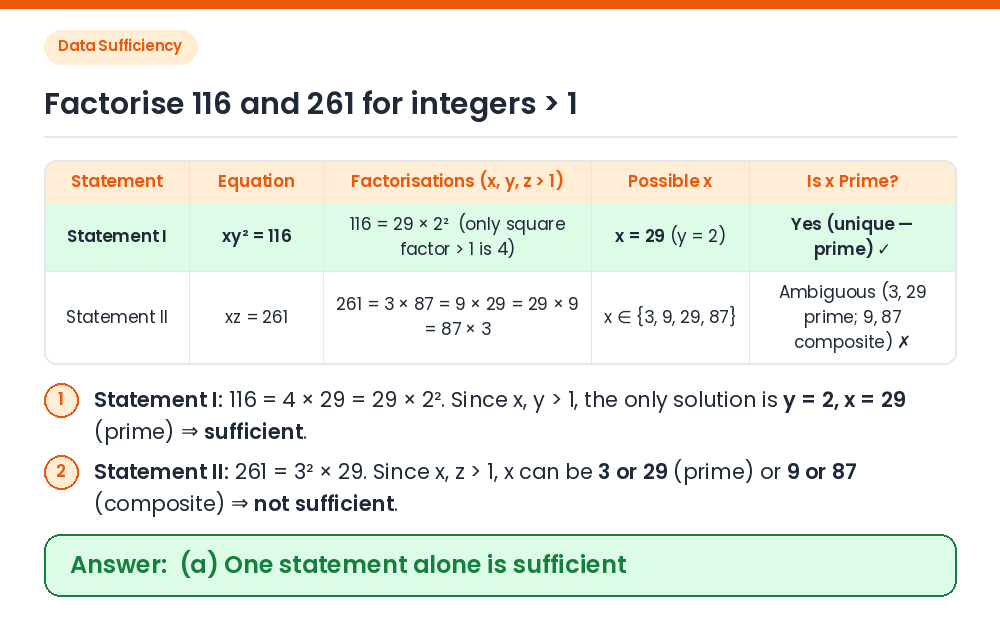
Given / Concept: x, y, z are integers > 1. Factorise the constants into prime powers. Check Statement I: xy² = 116 = 2² × 29. Since y > 1, y² must divide 116, so y = 2 and x = 29. Verify x from I: Since 29 is a prime number, Statement I alone uniquely answers 'Yes'. Check Statement II: xz = 261 = 3² × 29. With x, z > 1, (x, z) can be (3, 87), (9, 29), (29, 9), or (87, 3) ⇒ x can be prime (3, 29) or composite (9, 87) ⇒ not sufficient. Result: Statement I alone is sufficient while Statement II alone is not, so option (a) is correct. Shortcut: 116 has only one square factor > 1 (namely 4 = 2²), fixing x = 29 immediately. Correct Answer: (a) Can be answered using one of the statements alone, but not the other