Civil Services Examination · Question 3
Directions: This item contains a question followed by two statements. Answer the item using the following instructions: (a) Select this option if the question can be answered using one of these statements alone, but cannot be answered using the other statement. (b) Select this option if the question can be answered using either statement alone. (c) Select this option if the question can be answered using both the statements together, but cannot be answered using either statement alone. (d) Select this option if the question cannot be answered even using any of the statements. Question: If x and y are integers, then is x even? Statement I: x²y² is even. Statement II: 1 + x² + y² is odd.
Show answer & explanationShow explanation
Answer: (C) Can be answered using both statements together, but not either alone
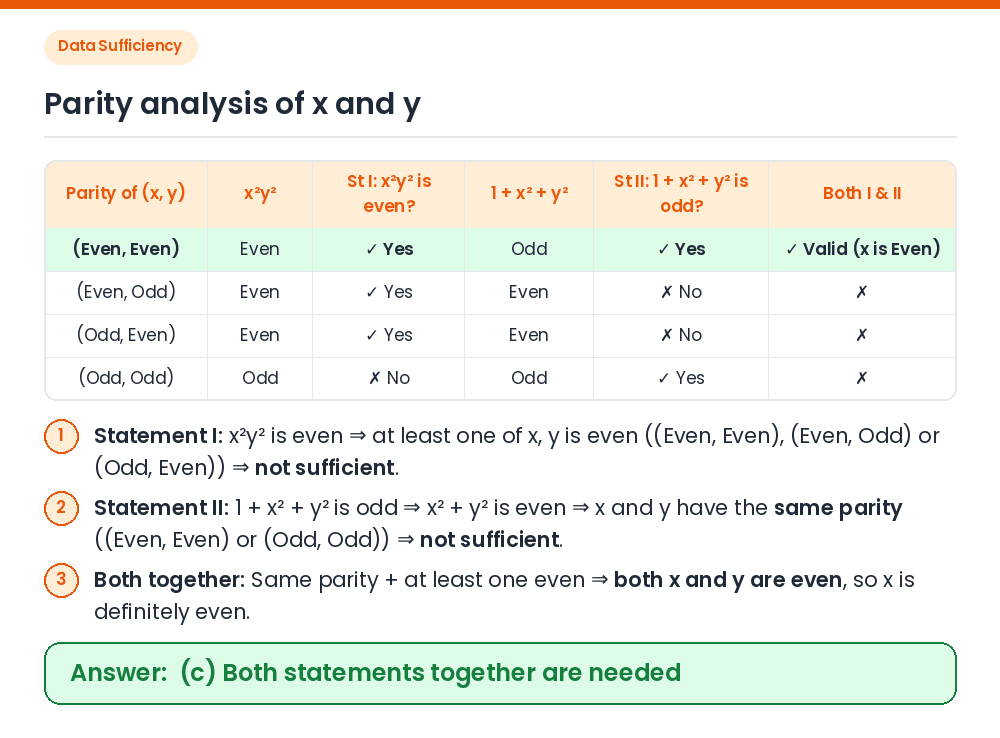
Given / Concept: Parity rules for integers x and y — a square n² has the same parity as n. Check Statement I: x²y² is even ⇒ xy is even ⇒ at least one of x or y is even (x could be odd and y even) ⇒ not sufficient alone. Check Statement II: 1 + x² + y² is odd ⇒ x² + y² is even ⇒ x and y are either both even or both odd ⇒ not sufficient alone. Combine I and II: Since x and y have the same parity (from II) and at least one is even (from I), both x and y must be even. Result: Both statements together are sufficient to conclude that x is even, but neither alone is sufficient. Shortcut: Statement I rules out (Odd, Odd); Statement II rules out mixed parity; together only (Even, Even) remains. Correct Answer: (c) Can be answered using both statements together, but not either alone