Civil Services Examination · Question 23
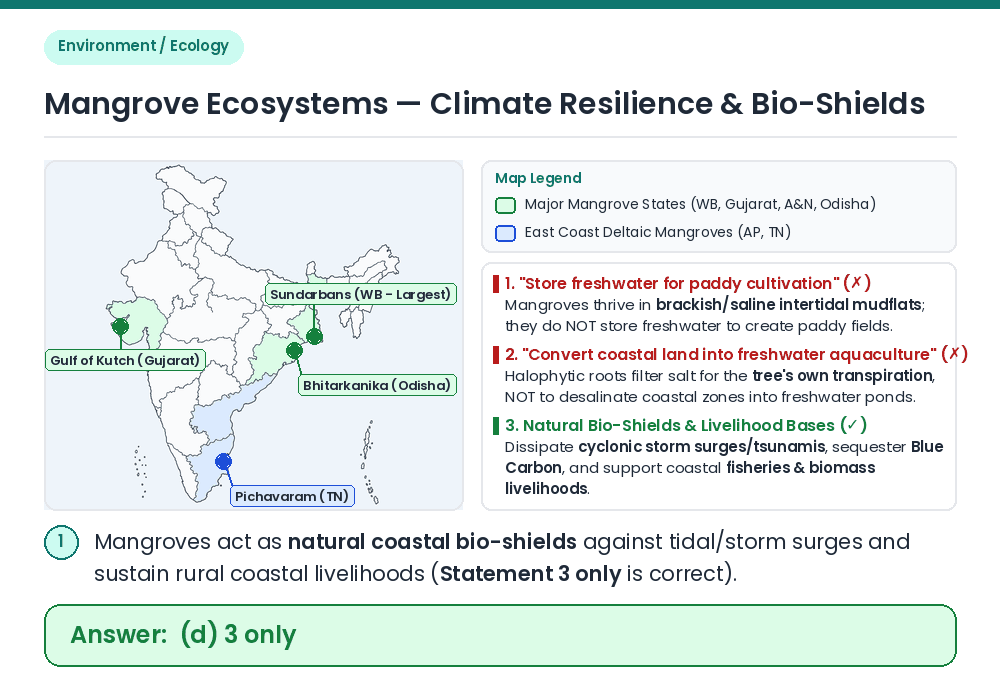
Which of the following best explain(s) the rationale for protecting mangrove ecosystems in the context of climate resilience ? 1. Mangroves reduce tidal energy and store freshwater, making them ideal sites for paddy cultivation in saline estuarine belts. 2. Their salt-sensitive roots filter seawater, making mangroves key to converting coastal land into freshwater aquaculture zones. 3. By withstanding tidal surges and offering biomass resources, mangroves function both as natural bio-shields and livelihood bases for rural communities. Select the answer using the code given below :
Show answer & explanationShow explanation
Answer: (D) 3 only
Concept: Mangroves are salt-tolerant (halophytic) intertidal forest ecosystems that provide critical coastal protection and carbon sequestration ('Blue Carbon'). Evaluate Statements 1 & 2: ⇒ Mangroves grow in saline/brackish tidal mudflats and do NOT store freshwater for paddy cultivation (in fact, clearing mangroves for paddy or shrimp ponds degrades them) — Statement 1 is incorrect; and while halophytic roots ultra-filter salt for the plant's internal sap, they do NOT desalinate coastal land into freshwater aquaculture zones — Statement 2 is incorrect. Evaluate Statement 3: ⇒ Dense prop roots and pneumatophores absorb wave and cyclonic storm-surge energy (acting as a natural bio-shield) while providing fish nurseries, honey, and biomass for coastal communities — Statement 3 is correct. Result: Only statement 3 is correct. Related Facts: Mangroves in India & MISHTI Initiative: • MISHTI Scheme (2023): 'Mangrove Initiative for Shoreline Habitats & Tangible Incomes' promotes mangrove afforestation along India's coastline. • Top Mangrove Cover in India (ISFR): West Bengal (Sundarbans, >40% of India's total), followed by Gujarat and Andaman & Nicobar Islands. Correct Answer: (d) 3 only