Civil Services Examination · Question 21
Consider the following statements with reference to India's response to climate change : I. India's Long-Term Low Emission Development Strategy (LT-LEDS) is a crucial tool for achieving net-zero emissions by 2070. II. India's 4th Biennial Update Report (BUR-4) submitted in December, 2024 recorded around 8% decrease in Greenhouse gas emissions in 2020 over 2019. III. Climate-resilient development necessarily depends on quick and short-term achievement of emission reduction targets. Which of the following relationships among the above statements is/are correct ? 1. Statement I is empirically supported by statement II. 2. Statement III contradicts the approach implicit in statement I. 3. Statement I and statement III together establish the premise of long-term sustainability. Select the answer using the code given below :
Show answer & explanationShow explanation
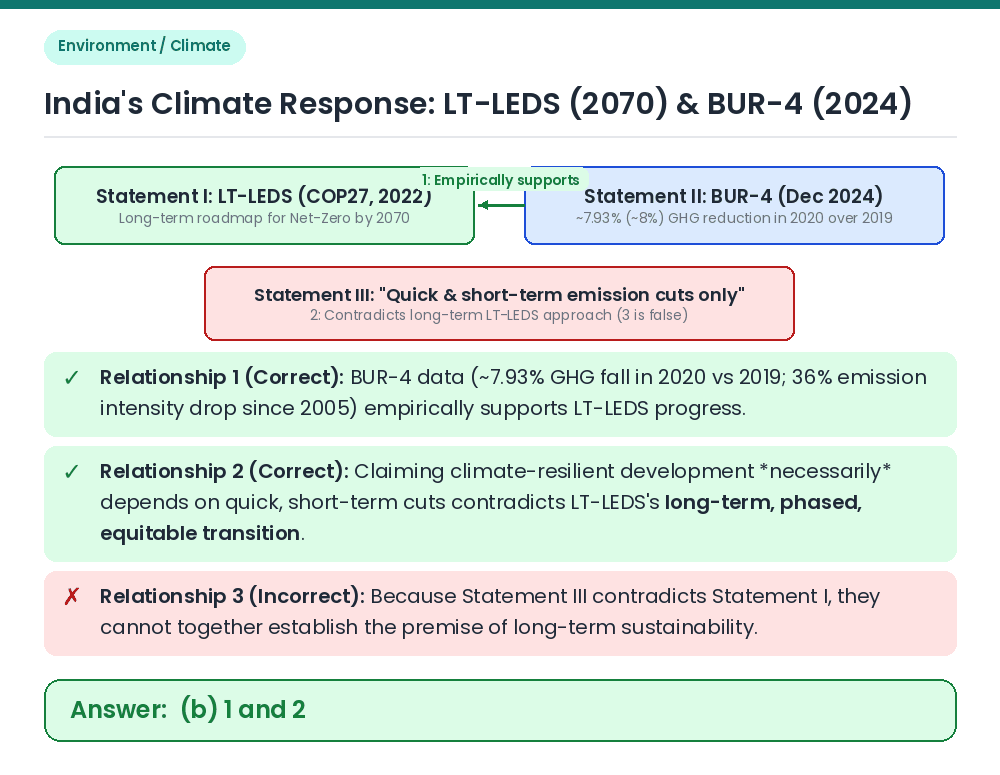
Answer: (B) 1 and 2
Concept: India's climate strategy balances long-term low-carbon transitions (LT-LEDS towards 2070 Net-Zero) with developmental equity and CBDR-RC. Evaluate Relationship 1: ⇒ Statement II (BUR-4 submitted to UNFCCC in Dec 2024 showing a 7.93% or ~8% reduction in GHG emissions in 2020 over 2019) provides empirical evidence supporting India's low-emission trajectory in Statement I — Relationship 1 is correct. Evaluate Relationships 2 & 3: ⇒ Statement III asserts that climate-resilient development necessarily depends on 'quick and short-term' emission cuts, which directly contradicts the long-term, phased approach of LT-LEDS in Statement I — Relationship 2 is correct, and consequently Relationship 3 is incorrect. Result: Relationships 1 and 2 are correct. Related Facts: Key Highlights of India's BUR-4 (December 2024): • Emission Intensity Reduction: Reduced by 36% between 2005 and 2020 (well on track for the 45% target by 2030). • Non-Fossil Fuel Capacity: Reached 46.52% of installed electric power capacity by October 2024, plus a carbon sink of 2.29 billion tonnes CO2 equivalent created during 2005–2021. Correct Answer: (b) 1 and 2