Civil Services Examination · Question 18
Consider the following assertion : The genesis of political alliances based on community lay in the very nature of the Montagu-Chelmsford Reforms, 1919. Which of the following statements support/supports the above assertion ? 1. Reforms retained and extended the principle of separate electorates. 2. Separate electorates were supposed to counter Indian nationalism, which was growing stronger. 3. Deprived classes rallied around the favours inherent in separate electorates. Select the answer using the code given below :
Show answer & explanationShow explanation
Answer: (D) 1, 2 and 3
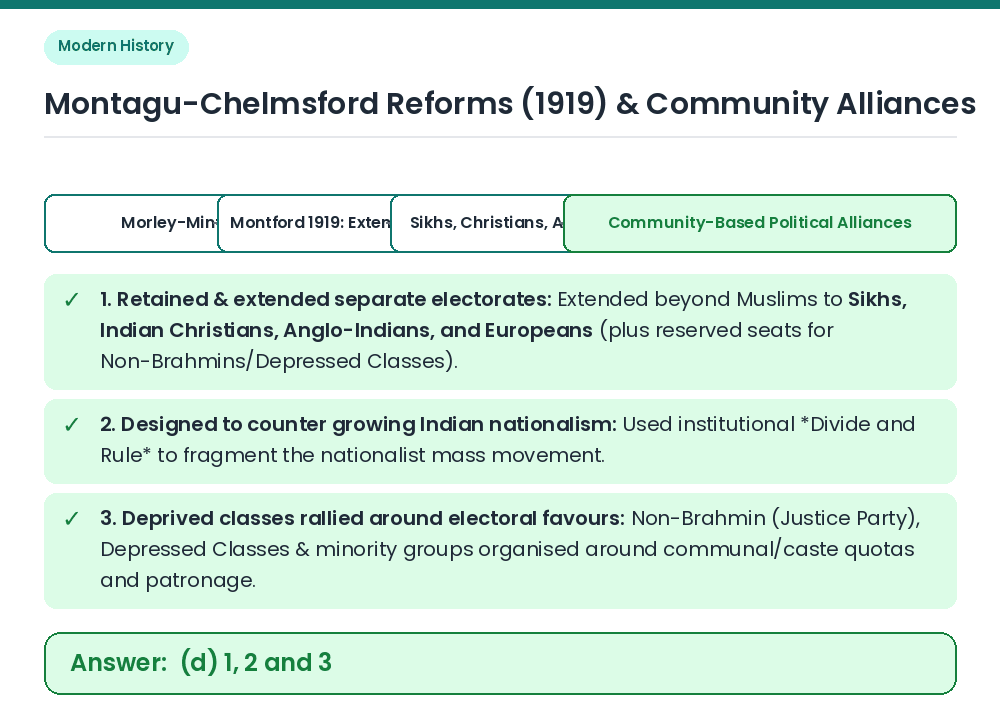
Concept: The Montagu-Chelmsford Reforms (Government of India Act, 1919) introduced provincial dyarchy and expanded communal and special-interest representation. Evaluate Statements 1 & 2: ⇒ Despite acknowledging the flaws of communal representation in the Montford Report, the 1919 Act retained separate electorates for Muslims and extended them to Sikhs, Indian Christians, Anglo-Indians, and Europeans (Statement 1 is correct), specifically to fragment and counter the rising tide of Indian nationalism (Statement 2 is correct). Evaluate Statement 3: ⇒ Because legislative representation and ministerial patronage under dyarchy were tied to community quotas and special nominations, deprived and non-dominant groups rallied around separate electorates and reserved seats to secure political share (Statement 3 is correct). Result: All three statements 1, 2 and 3 support the assertion. Related Facts: Key Features of the Government of India Act, 1919: • Provincial Dyarchy: Divided provincial subjects into 'Transferred' (administered by Ministers responsible to the legislature) and 'Reserved' (administered by the Governor and Executive Council). • Bicameral Central Legislature: Created the Council of State (Upper House) and Central Legislative Assembly (Lower House). Correct Answer: (d) 1, 2 and 3