Civil Services Examination · Question 17
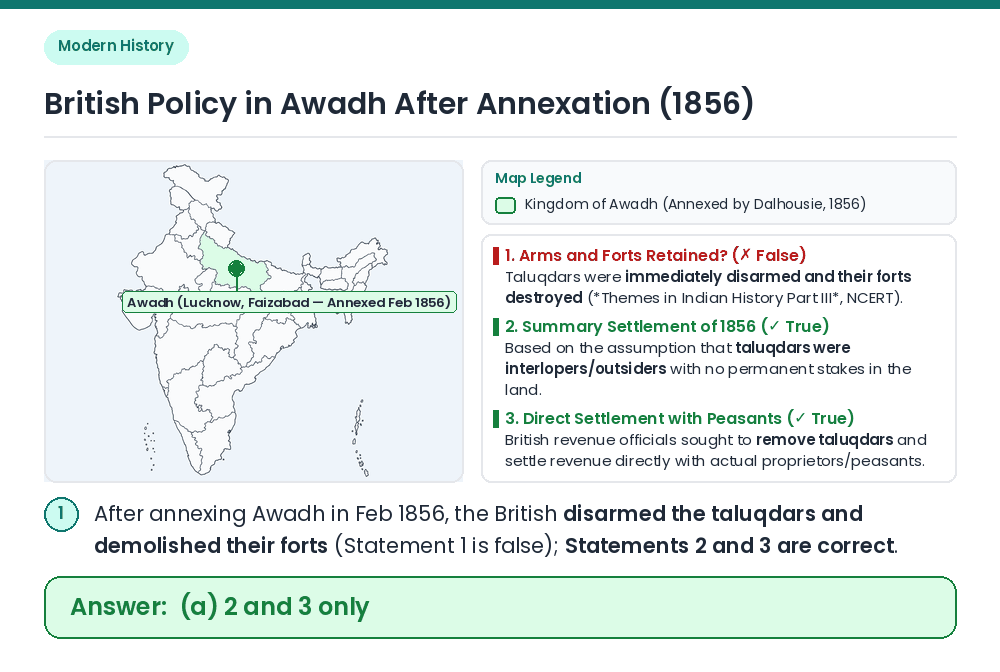
Consider the following statements regarding the British policy in Awadh immediately after its annexation in 1856 : 1. The taluqdars were dispossessed of their estates but allowed to retain their arms and forts. 2. A Summary Revenue Settlement was made in 1856 assuming that the taluqdars were outsiders. 3. The British believed in taking revenue directly from the peasants by removing the taluqdars. Which of the statements given above is/are correct ?
Show answer & explanationShow explanation
Answer: (A) 2 and 3 only
Concept: Following Lord Dalhousie's annexation of Awadh in February 1856 on charges of misgovernance, the British introduced the first Summary Revenue Settlement of 1856. Evaluate Statement 1: ⇒ As explicitly stated in Class XII History NCERT ('Rebels and the Raj'), immediately after annexation the taluqdars were disarmed and their forts were destroyed — Statement 1 is incorrect. Evaluate Statements 2 & 3: ⇒ The Summary Settlement of 1856 proceeded on the assumption that taluqdars were interlopers ('outsiders') with no permanent stake in the land, and sought to remove them so the state could collect revenue directly from village proprietors/peasants (reducing taluqdars' share of villages from 67% to 38%) — Statements 2 and 3 are correct. Result: Statements 2 and 3 only are correct. Related Facts: Impact on the Revolt of 1857 in Awadh: • Peasant Disillusionment: Direct revenue assessment was so over-pitched (by 30% to 70%) that peasants were equally aggrieved. • Taluqdar–Peasant Alliance: Dispossessed taluqdars and over-taxed peasants united under Begum Hazrat Mahal in Lucknow during the 1857 Revolt. Correct Answer: (a) 2 and 3 only