Civil Services Examination · Question 14
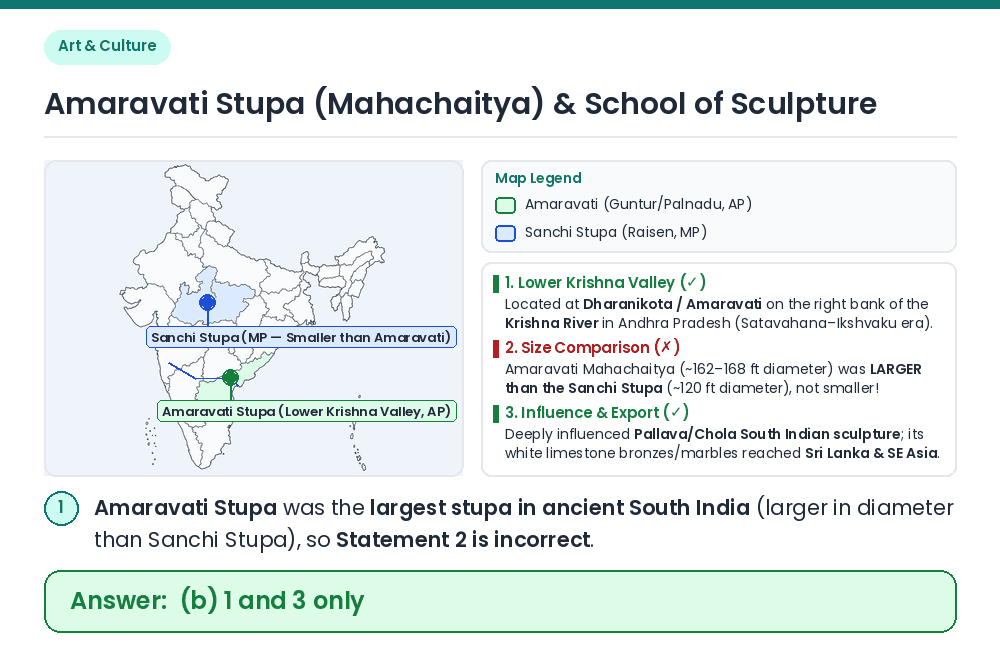
Which of the following statements on the Amaravati Stupa and its relief sculpture is/are correct ? 1. It was located in the lower Krishna valley. 2. In India, it was next only to the Sanchi Stupa in size. 3. The Amaravati school of sculpture made a lasting impact on the later South Indian sculpture, and its products were carried to Sri Lanka and South-east Asia. Select the answer using the code given below :
Show answer & explanationShow explanation
Answer: (B) 1 and 3 only
Concept: The Amaravati Mahachaitya (in Guntur/Palnadu district, Andhra Pradesh) flourished between the 2nd century BCE and 3rd century CE under the Satavahanas and Ikshvakus. Evaluate Statement 1: ⇒ It was situated at Dharanikota/Amaravati on the banks of the Krishna River in the lower Krishna valley — Statement 1 is correct. Evaluate Statement 2: ⇒ The Amaravati Stupa (dome diameter ~42–50 m / ~162 ft, height ~30 m) was actually larger than the Great Stupa at Sanchi (diameter ~36.6 m / 120 ft, height ~16.5 m), and the largest stupa excavated in India is Kesariya Stupa in Bihar — Statement 2 is incorrect. Evaluate Statement 3 & Result: ⇒ Amaravati's dynamic white-limestone ('Palnad marble') narrative reliefs strongly shaped Pallava and Chola art and were exported to Sri Lanka (Anuradhapura) and South-East Asia — Statement 3 is correct, making (b) 1 and 3 only the right answer. Related Facts: Key Features of Amaravati Art: • Material & Patronage: Crafted in greenish-white Palnad limestone under Satavahana and Ikshvaku patronage. • Ayaka Pillars: Featured five free-standing pillars ('Ayaka-khambhas') on projections at the four cardinal directions. Correct Answer: (b) 1 and 3 only