Civil Services Examination · Question 10
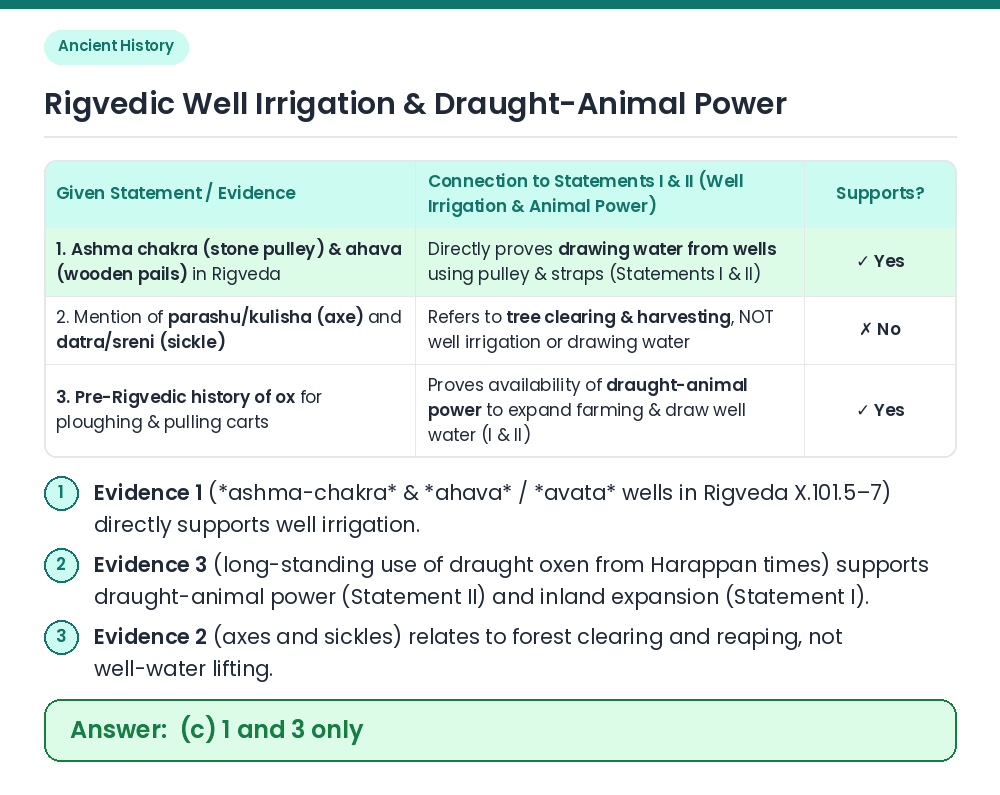
Consider the following statements about the Rigvedic period : I. Irrigation from wells allowed agriculture to expand away from flood plains and strips on river margins into the present Punjab and Haryana plains having underground water levels reasonably close to the surface. II. Draught-animal power was employed to draw up water out of the wells. Which of the following information support/supports the above statements ? 1. There is evidence in the Rigveda of the use of ashma chakra (stone pulley wheel) and ahava (strapped wooden pails) to draw up water. 2. Mention has been made in the Rigveda of the use of implements like parashu/kulisha (axe) and datra/sreni (sickle). 3. There is a history of the use of ox, even before the Rigveda, for ploughing the land and pulling the carts. Select the answer using the code given below :
Show answer & explanationShow explanation
Answer: (C) 1 and 3 only
Concept: Statements I and II (drawn from Irfan Habib's 'The Vedic Age' / 'Man and Environment') explain how well irrigation and animal traction enabled Rigvedic agriculture in the Punjab–Haryana plains. Evaluate Information 1 & 3: ⇒ Rigveda (Mandala X.101.5–7) explicitly mentions 'avata' (wells), 'ashma-chakra' (stone pulley wheel), 'varatra' (straps), and 'ahava'/'kosha' (wooden pails/troughs) drawn by horses/oxen (Information 1 supports I & II); and the pre-Rigvedic (Harappan) tradition of draught oxen for traction and ploughing supports the use of draught-animal power (Information 3 supports I & II). Evaluate Information 2: ⇒ While axes (parashu/kulisha) and sickles (datra/sreni) are mentioned in the Rigveda, they are tools for wood-cutting and harvesting and do not support well irrigation or animal-powered water lifting. Result: Only information 1 and 3 support the given statements. Related Facts: Rigvedic Agrarian Terms: • Avata: Artificial well dug into the ground (contrasted with 'utsa', a natural spring). • Langala / Sira: Wooden plough drawn by oxen; Kshetra: cultivated field; Yava: barley. Correct Answer: (c) 1 and 3 only