Civil Services Examination · Question 11
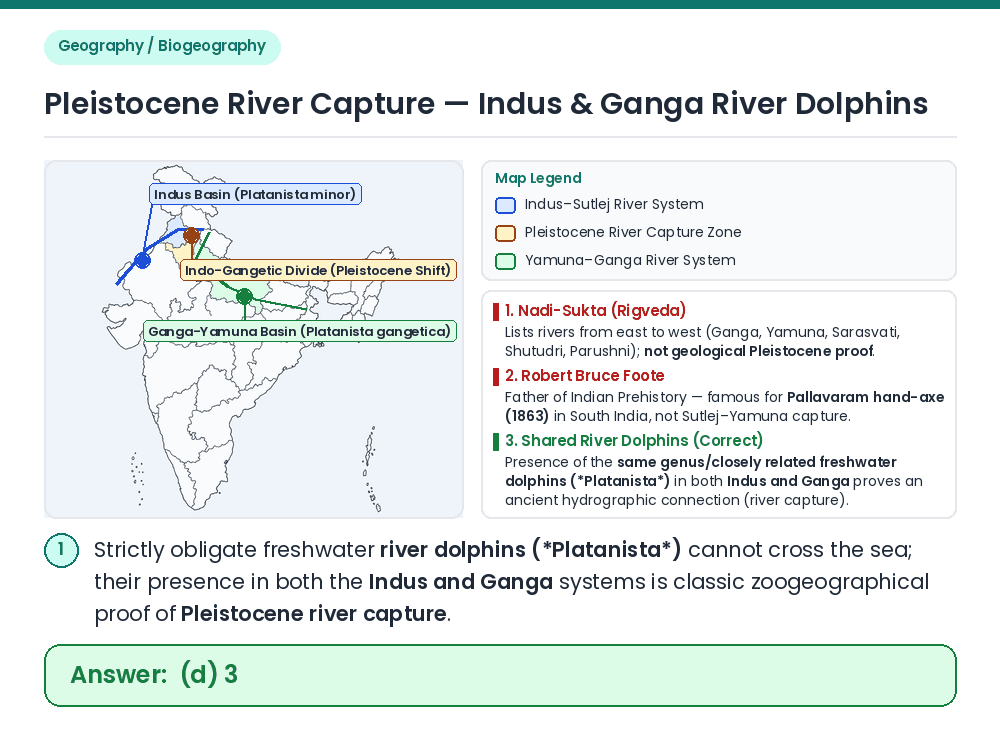
Consider the following assertion : In the Pleistocene period either the Yamuna once flowed into the Indus, or the Sutlej flowed into the Yamuna and one major tributary of either had shifted from the Ganga to the Indus or vice versa. Which of the following is/are the basis of the above assertion ? 1. The Nadi-Sukta of the Rigveda 2. The explorations of the Sutlej and the Yamuna by Robert Bruce Foote 3. The presence of the same species of dolphins in both the Indus and the Ganga river systems Select the answer using the code given below :
Show answer & explanationShow explanation
Answer: (D) 3
Concept: Obligate freshwater fauna that cannot migrate through saline ocean waters provide definitive biogeographical evidence of past drainage connections (river capture) between separate river basins. Evaluate Basis 3: ⇒ Both the Indus and Ganga-Yamuna river systems are inhabited by the South Asian river dolphin (Platanista gangetica / Platanista minor), proving that in the Pleistocene period a major tributary (Yamuna or Sutlej) shifted between the Indus and Ganga systems (as propounded in the 'Indobrahm' / Siwalik river hypothesis of E.H. Pascoe and B. Prashad) — Statement 3 is the correct basis. Eliminate 1 & 2: ⇒ The Nadi-Sukta (Rigveda X.75) belongs to the proto-historic Vedic period (not the Pleistocene geological epoch), and Robert Bruce Foote worked primarily on Palaeolithic sites in Peninsular India (Pallavaram, Kortallaiyar valley, Gujarat). Result: Only statement 3 is the basis of the assertion. Related Facts: South Asian River Dolphins: • Scientific Classification: Platanista gangetica (Ganges river dolphin, India's National Aquatic Animal) and Platanista minor (Indus river dolphin, also found in Beas). • Geomorphic Shift: Neotectonic uplift of the Delhi–Hardwar ridge (Potwar/Ambala divide) diverted the paleo-Yamuna eastward into the Ganga and the Sutlej westward into the Indus. Correct Answer: (d) 3