Civil Services Examination · Question 7
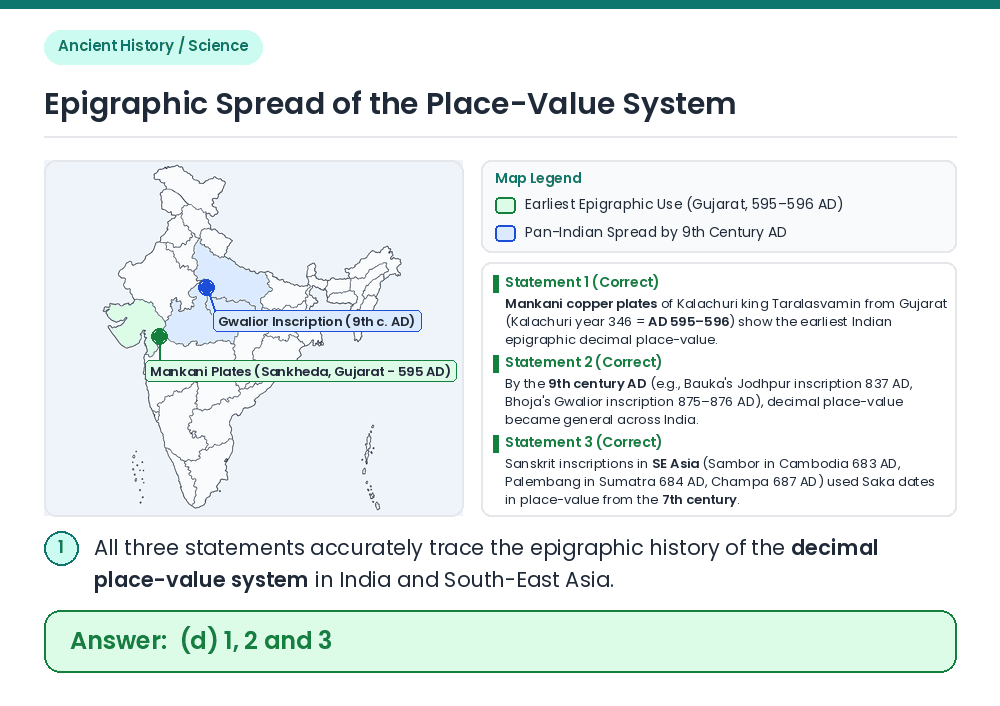
Consider the following statements relating to the use of the place-value system in India : 1. The earliest epigraphic use of the place-value system in India is found in the Mankani plates from Gujarat (AD 595 – 596). 2. In the ninth century, place-values become general in inscriptions all over India. 3. The place-values have been found in Sanskrit inscriptions in South-east Asia as early as the seventh century. Which of the statements given above are correct ?
Show answer & explanationShow explanation
Answer: (D) 1, 2 and 3
Concept: India's decimal place-value notation (with zero) appeared first in astronomical/literary texts (Aryabhatiya, Lokavibhaga) and then in copper-plate and stone inscriptions. Evaluate Statement 1: ⇒ The Sankheda/Mankani copper-plate grant from Gujarat (dated Kalachuri year 346 = AD 595–596) contains the earliest known epigraphic decimal place-value numeral in India (as noted by A.L. Basham in 'The Wonder That Was India') — Statement 1 is correct. Evaluate Statements 2 & 3: ⇒ By the 9th century AD, decimal place-value numerals became standard across Indian inscriptions (e.g. Gwalior inscription, AD 876), while Sanskrit/Old Khmer inscriptions in South-East Asia (Sambor, Cambodia, AD 683; Kota Kapur/Kedukan Bukit, AD 683–686) already used decimal place-value in the 7th century — Statements 2 and 3 are correct. Result: All three statements 1, 2 and 3 are correct. Related Facts: Milestones of Zero and Place-Value: • Bakhshali Manuscript: Uses a dot (bindu) as a zero placeholder in mathematical calculations. • Chaturbhuj Temple Inscription (Gwalior, AD 876): Explicitly inscribes the symbol '0' in numbers 270 and 50. Correct Answer: (d) 1, 2 and 3