Civil Services Examination · Question 3
Consider the following statements : I. Pali texts contain the first definite references to coins, e.g., kahapana, nikkha, kamsa, and kakanika. II. The literary evidence from Pali texts is corroborated by archaeological evidence of punch-marked coins from many sites, most of them made of silver. The above statements have been associated with which of the following ? 1. Emergence of urban life 2. Transition to money economy Select the answer using the code given below :
Show answer & explanationShow explanation
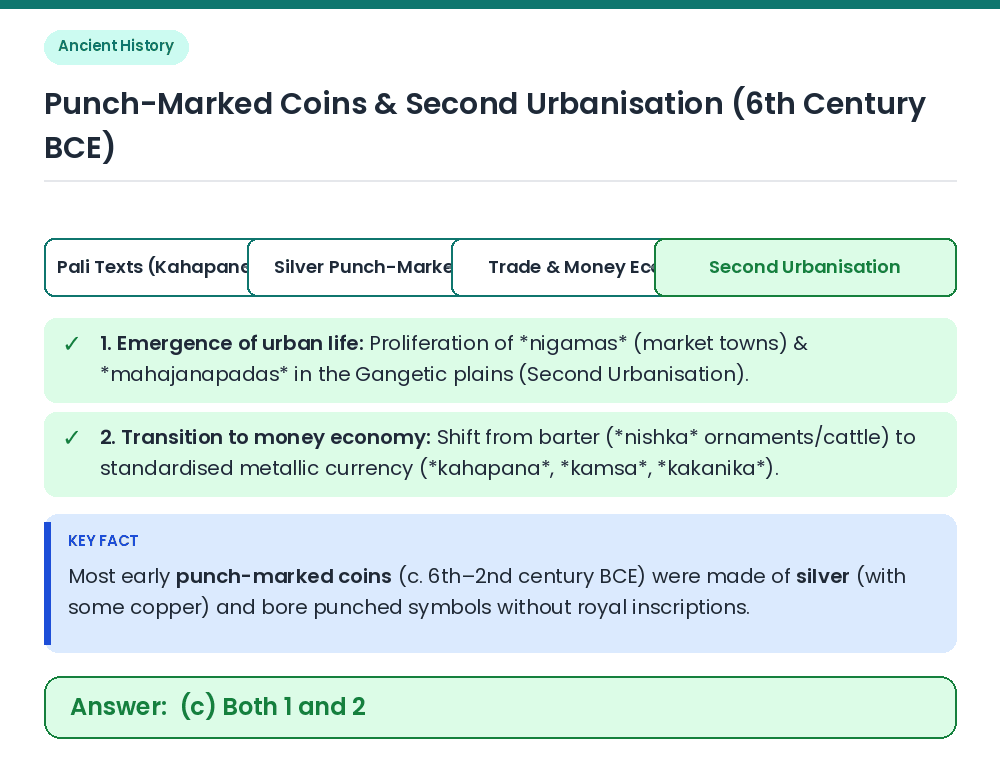
Answer: (C) Both 1 and 2
Concept: During the 6th century BCE (Age of the Buddha), the middle Gangetic basin witnessed the Second Urbanisation alongside coined metallic money. Evaluate Point 1 — Emergence of Urban Life: ⇒ Archaeological layers with Northern Black Polished Ware (NBPW) and silver punch-marked coins directly mark the rise of towns and craft guilds — Point 1 is correct. Evaluate Point 2 — Transition to Money Economy: ⇒ Pali references to kahapana, nikkha, kamsa, and kakanika reflect regular monetised exchange replacing barter — Point 2 is correct. Result: Both 1 and 2 are associated with the given statements. Related Facts: Early Indian Coinage: • Punch-Marked Coins: Called 'Pana' or 'Karshapana' (Kahapana in Pali), weighing 32 rattis (~3.7 grams). • Indo-Greeks: Later introduced die-struck coins bearing royal portraits and inscriptions in the 2nd century BCE. Correct Answer: (c) Both 1 and 2