Civil Services Examination · Question 2
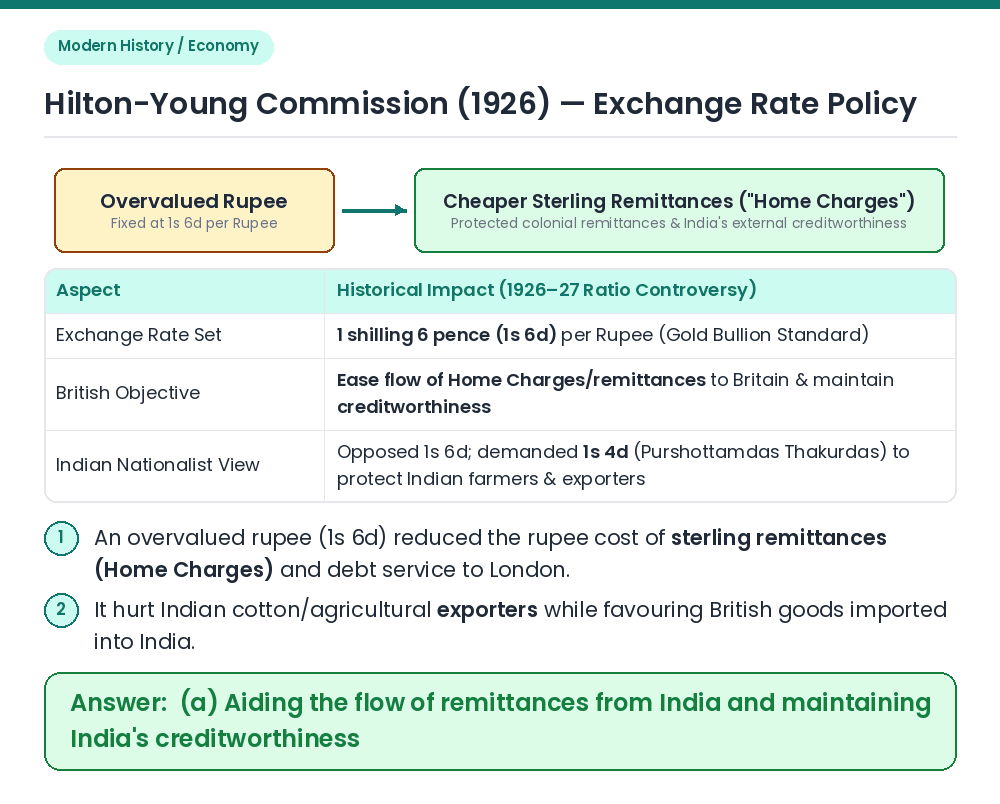
The artificially fixed rupee-sterling exchange rate prescribed by the Hilton-Young Commission (1926) was adopted by the British Government for which one of the following reasons?
Show answer & explanationShow explanation
Answer: (A) Aiding the flow of remittances from India and maintaining India's creditworthiness
Concept: The Royal Commission on Indian Currency and Finance (Hilton-Young Commission, 1926) fixed the rupee at 1 shilling 6 pence (1s 6d) sterling. Analyse Colonial Motive: ⇒ An overvalued rupee (1s 6d instead of the pre-war 1s 4d) meant fewer rupees were needed by the colonial government to remit sterling 'Home Charges', pensions, and debt servicing to London. Evaluate Other Options: ⇒ Overvaluation penalized Indian cotton exporters and helped British exporters (not Indian importers or domestic producers). Result: Thus, the rate was adopted to aid the flow of remittances from India and maintain India's sterling creditworthiness. Related Facts: Key Points on the Hilton-Young Commission: • RBI Recommendation: It recommended setting up a central bank, leading to the Reserve Bank of India Act, 1934. • Dissent Note: Sir Purshottamdas Thakurdas wrote a famous minute of dissent advocating the 1s 4d ratio. Correct Answer: (a) Aiding the flow of remittances from India and maintaining India's creditworthiness