Civil Services Examination · Question 12
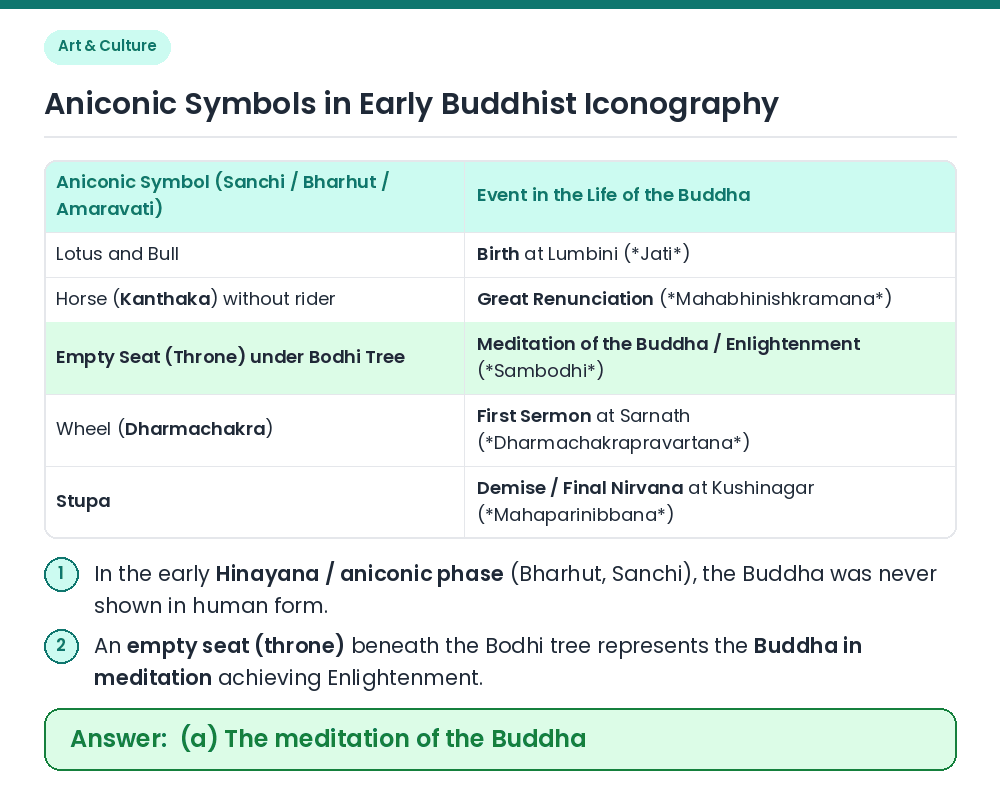
What does an empty seat represent in early Buddhist iconography ?
Show answer & explanationShow explanation
Answer: (A) The meditation of the Buddha
Concept: In early Buddhist art (Bharhut, Sanchi, early Amaravati), the Buddha was represented through aniconic symbols rather than anthropomorphic (human) images. Match the Empty Seat: ⇒ As explicitly stated in NCERT ('Themes in Indian History Part I' / 'An Introduction to Indian Art'), the empty seat (vajrasana/throne) indicates the meditation of the Buddha. Match Other Symbols: ⇒ The wheel (Dharmachakra) represents the First Sermon at Sarnath, the Stupa represents Mahaparinibbana, and the riderless horse represents Mahabhinishkramana (Great Departure). Result: An empty seat represents the meditation of the Buddha. Related Facts: Transition to Anthropomorphic Images: • First Human Images (1st Century CE): Developed simultaneously under the Gandhara and Mathura schools of art during the Kushana period. • Chhatra (Parasol) & Footprints (Buddhapada): Also used in early reliefs to signify the sacred presence of the Buddha. Correct Answer: (a) The meditation of the Buddha