Civil Services Examination · Question 54
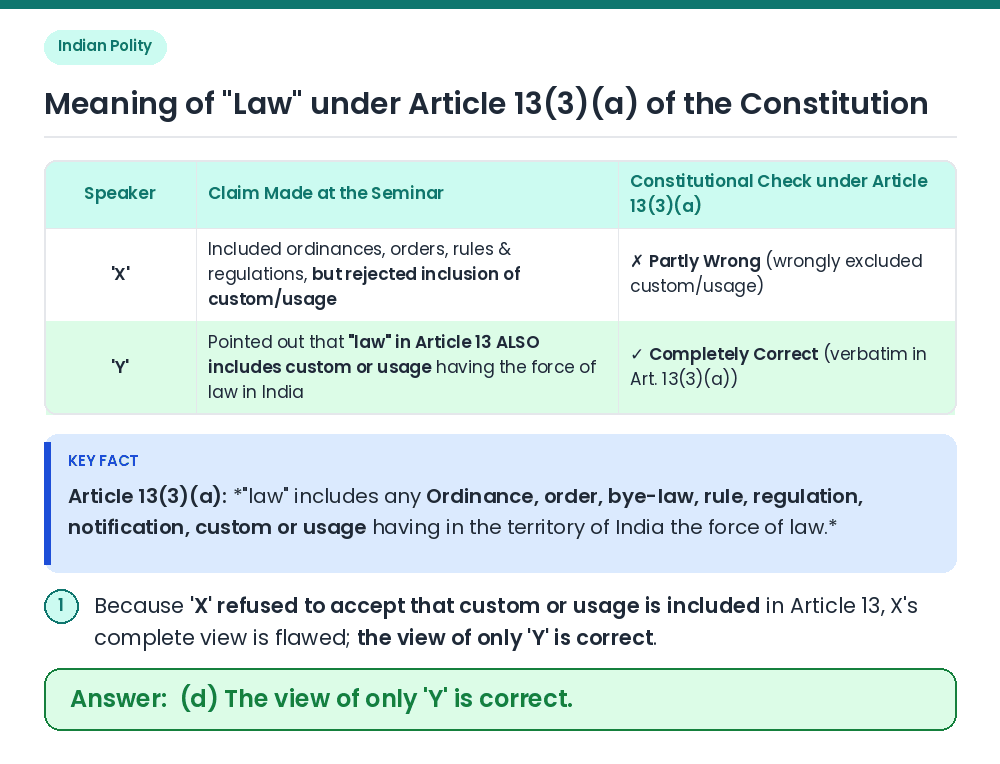
'X' was addressing a seminar on the meaning of the term 'law' as provided under Article 13, Part III of the Constitution of India. 'X' explained that the meaning of the term 'law' in the Constitution of India was very comprehensive. It included ordinances, orders and even rules and regulations. 'Y' pointed out that the term 'law' in Article 13 also included custom or usage having in the territory of India the force of law, to which 'X' was not convinced. Based on the above, select the correct conclusion from the options given below :
Show answer & explanationShow explanation
Answer: (D) The view of only 'Y' is correct.
Concept: Article 13(3)(a) in Part III of the Constitution of India explicitly defines the term 'law' for the purpose of judicial review of Fundamental Rights. Step 2 (Read Article 13(3)(a) Verbatim): ⇒ Under Article 13(3)(a), 'law' includes 'any Ordinance, order, bye-law, rule, regulation, notification, custom or usage having in the territory of India the force of law'. Evaluate 'X' vs 'Y': ⇒ 'Y' is completely accurate in pointing out that custom or usage having the force of law is included alongside ordinances, orders, rules, and regulations; because 'X' was not convinced and rejected the inclusion of custom/usage, 'X's overall position is incorrect (so both X and Y cannot be simultaneously correct when they directly disagree on custom). Result: Therefore, the view of only 'Y' is correct. Related Facts: Key Provisions of Article 13: • Article 13(4) (Added by 24th Amendment Act, 1971): Clarifies that nothing in Article 13 shall apply to any amendment of the Constitution made under Article 368 (upheld in Kesavananda Bharati, subject to the Basic Structure doctrine). • Personal Laws & Custom: While customs having the force of law are explicitly covered by Article 13(3)(a) (e.g., Sabarimala / Shayara Bano discussions), uncodified personal laws were historically debated under State of Bombay v. Narasu Appa Mali (1951). Correct Answer: (d) The view of only 'Y' is correct.